Decorated Pipe from wreck of Confederate Blockade Runner!
Click to Enlarge |
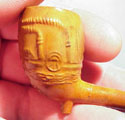
A very lovely smoking pipe of an umber-brown clay. It was salvaged from the underwater wreckage of a Confederate blockade runner near Brownsville, Texas. The raised designs on its bowl show: A CW period locomotive and a Paddlewheeler. This is much fancier than the majority of smoking pipes used by ground troops. Tobacco and coffee were two great comforts to the common soldier and officer alike on both sides of the picket lines.
Civil War Period Patriotic Matchsafe

Click to Enlarge |
This is a nickel-plated brass matchsafe from the Civil War period, showing the common flip-top design. Matches were struck upon the serated edge, being used to light cigars, pipes, tent stoves and camp fires. There is a wonderfully bold American eagle and U.S. Shield design impressed on both sides. While metal was the most common, match safes were also made of gutta percha and rarely wood.
Clay Pipe bowl with a gnarly face design1

Click to Enlarge |
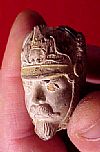
Since smoking pipes in camp was so popular, clay pipes ranged from the plain white clay bowl to those with flaboyant and fantastic images incorporated into their design. This pipe bowl shows a bearded whizzened gent wearing a colored cap and a military collar insignia. The site of discovery is unknown.
English Grenadier Pipe Bowl
Click to Enlarge |
From England, this buff clay pipe bowl shows the head of a fancy English Grenadier. No stem. Some edge chips to bowl but sturdy.
Frog Riding a Fish Brown Clay Pipe Bowl
Click to Enlarge |
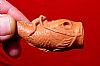
Smoking cheap clay pipes in camp was an important passtime for troops as the chatted after meals or in the evenings. Some bowls were molded in quite decorative motifs while others were plain. When the stems broke off, they were discarded in camp trash pits. This one in brown clay is very cute: a frog riding a fish! Imagine the man who was firing a hot musket in the midst of a deadly charge later that day settling back to smoke from such a pipe!!!
Black clay pipe of Hot Air Balloon
Click to Enlarge |
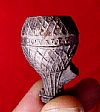
This clay pipe bowl depicts the shape and design of a hot-air observation balloon. While the invention of the airplane was still forty years into the future, balloons would occasionally be sent aloft to spy upon the details of enemy fortifications and troop deployments. Yet, it was not as easy to do this during the Civil War as later during World War I (1914-1918) when many dirigibles and observation balloons hovered over the deadly trenched mazes of Europe.
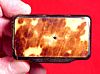
Period tortoise shell and gutta percha Snuff Box
Click to Enlarge |
Snuff was still popular from earlier generations. It was carried in wooden, brass or silver boxes. Then a pinch was taken from the supply in the box and sniffed up into a nostril, causing a tingle and sometimes a sneeze. In the era of the American Civil War, the more durable and affordable gutta percha was commonly used to construct rectangular and ovoid boxes with flip-tops or snapping lids. This one is adorned with a tortoise shell insert on the top.
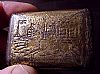
Camp-Site Matchsafe
Click to Enlarge |
This is a nickle-plated brass matchsafe that bears similar engraved images of a CW soldier's encampment on each side... It has a corrugated match-striker section along one end... Measures 2 1/4" by 1 1/2"... Imagine it sitting in the pocket of a man firing a rifle desperately at Gettysburg, wondering if he will live or die in the next ten minutes...
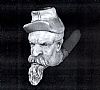
Pipe Bowl carved as Soldier's Head
Click to Enlarge |
This is a wonderful old tobacco pipe carved in the shape of a grizzly old bearded soldier's head wearing a kepi cap. The expression and detail are stunning. It measures about 5 1/4 inches in length and 2 3/8 inches high. Imagine some tough old Union sergeant puffing away on such a pipe which looked just like him the very night before he fought at Gettysburg. Some Civil War soldiers actually did endure battles with their pipes hanging from their mouths
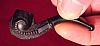
Tiny Gutta Percha Eagle Claw Pipe
Click to Enlarge |
This is a very small "eagle claw" gutta percha pipe. It is functional! No flaws. Talk about a quick drag! Only about 2 1/4" overall length.
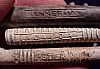
Clay Pipes were Big Business with huge Armies
Click to Enlarge |
Many companies in United States and England supplied inexpensive white clay pipes to troops who loved tobacco in the evening while stationed in a camp. These pipes are discovered in large numbers in trash pits, often with their fragile clay stems broken off. The designs on their bowls are varied and interesting. Butm, the names of their manufacturers molded into the stems are sometimes more curious! Here is a sampling of broken stems with makers' names.
|