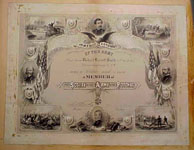
Veterans Document for First Lt. Robert Burnett Smith, 11th US Ind. SIGNED BY U.S. GRANT!!!!
Click to Enlarge |
A Splendid Engraved Document attesting to Robert Smith's
membership in the Society of the Army of the Potomac. Signed in ink by U.S. Grant, President. Vignettes of battles,
Meade, Hooker, Burnside, McClellan, and their battles.
Large 16 x 21"!
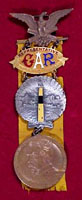
1910 GAR National Encampment Badge
Click to Enlarge |
The yearly GAR conventions were large, gala events with not only national assemblies but state meetings of delegates as well. The GAr coordinated not simply their own veterans affairs but were instrumental in donating to important charities and local municipal projects. When the GAR descended upon a resort city for their yearly conventions, hotels were booked, restaurants filled and local cultural events saturated by the visitors. Official representatives were given various pins, badges and ribbons. The large one shown was supplied to State Delegates. This bears the image of General Kearny. It is dated for the convention: Sept.1910/ 44th Nat'l Encampment. These medals were made during the "golden age" of artistry for such items. Note the actual colored enamelling of the letters "GAR". As years went on, less and less Civil War Vets were around to attend conventions, making the Encampment badges for the 1940's decade very scarce ones.
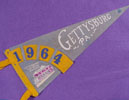
1964 Gettyburg Centennial Tourist Flag
Click to Enlarge |
A pennant flag sold to tourists visiting Gettysburg, Pennsylvania in 1964. It shows the Gettysburg National Museum and bears the motto "Gettysburg, PA". It is 12" long. Crowds at battlefields were large for the Civil War Centenial period of the Nineteen Sixties.
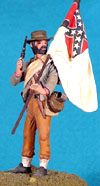
Painted Figure of a CONFEDERATE FLAG BEARER
Click to Enlarge |
Modern Military enthusiasts still hand-paint models of soldiers in either the traditional lead or more-recent resins. The detailing is very exact. Standing about 2-4 inches high, the best of these show fine facial features, smudges on clothes, various grades of tonality & texture. Work on one piece could take a week. Lesser-quality works are also being churned-out from shops in the Orient or South America. The Confederate Flag Bearer depicted here was created by Matthew Catania, Esquire, an avid enthusiast of military miniature work for over 30 years. It displays a vivid, overall excellent detail. 90 mm. height. Upon a handmade custom wooden base.
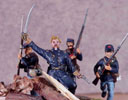
LITTLE ROUND TOP DIORAMA
Click to Enlarge |
A very nice diorama of Joshua Chamberlain, and three
soldiers from the 20th Maine, atop the rocky crest of Little Round Top. Soldiers are upon real granite stones! Actual
wooden Breastworks! 75 mm/ Pewter. By Matt Catania.
A splendid, custom job!!
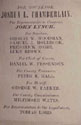
Campaign Flier for Joshua Chamberlain
Click to Enlarge |
Very interesting small handbill, distributed during Joshua
Chamberlain's campaign for Governor of Maine. General Chamberlain was the hero of Little Round Top at Gettysburg, later receiving the Congressional Medal of Honor for his gallant role in saving the day for the Union side at Gettysburg. He later become President of Boudoin College in Maine for many many years, and also, served as Governor of the State of Maine. An astonishing American of guts, conviction & diversity. This handbill also lists
the rest of his political party's ticket. 4 1/4" by 3".
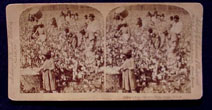
Stereocard of Blacks picking Cotton
Click to Enlarge |
Picking cotton before the Civil War as an unpaid slave... and... picking cotton after the war as "freed" paid citizens. The definitions changed but the treatment and attitudes remained much the same until the Civil Rights Movement of the Nineteen Sixties eventually brought new enlightenment to the minds of future generations as far as equality and real brotherhood. This is a Stereocard by "Strohmeyer & Wyman Publishers, NY" from about 1900. "Cotton is King, Plantation Scene, Georgia, USA"
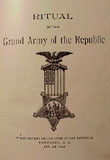
1906 GAR Ritual Book
Click to Enlarge |
Nice hardcover book (6 1/2" x 4 1/2") from "Headquarters of GAR, Washington, DC, Jan.1st,1906" Contains all the
approved protocols, seating, ciphers and ceremonies of the Union Veterans of Civil War who joined this huge organization. Last veteran members died in Nineteen Forties.
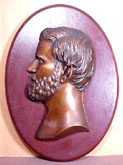
Bronze Life Sized Wall Plaque Bust of U.S. Grant from GAR Hall.
Click to Enlarge |
This is a life-sized bronze plaque of Ulyssess S. Grant in a detailed, heroic profile, mounted on a thick oval oak plaque board. Cast into shoulder curve is : "US GRANT Lieut Gen 1865"
and "Wm Miller & Co Medallists, Providence RI, F.Simmons,Sculp." Measures full 20" x 18". From a GAR Hall. Though ruthless in his determination to win the war, casting tens of thousands of men against the enemy in a bloddy war of attrition, Grant was most-beloved by his men for being both crafty in strategy and confident enough to use the full power at his disposal to end what otherwise would've been a much longer bloody stalemate. Grant was honored greatly after the war, being invited to speak at many Veteran functions. He was elected president of the Society of the Army of the Potomac, and eventually, became President of the United States of America. He wrote his military memoires. But sadly, a heavy smoker of cigars, he developed throat cancer and suffered a slow, painful demise. He temple-like tomb stands along the river drive in Manhattan.
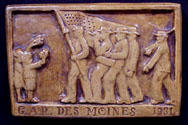
1931 Tile Plaque for Des Moine GAR Encampment: Student Designed.
Click to Enlarge |
This is a 9" x 6" mold-poured plaster plaque depicting GAR soldiers on parade, which according to the paper label on back, was designed and presented to vets by Des Moine public school students for the 1931 National Encampment in Des Moines. It demonstrates how grandchildren and great-grandchildren were still honoring the battle sacrifices of their forefathers, even during the Great American Depression and as the threat of a horrific World War II began to loom in Europe.
10th Corps badge: Identified to a Gettysburg Soldier

Click to Enlarge |
This is a 10th Corps badge with a central red velvet field for the 1st Division. To boost morale in the Union army after early defeats, General Joseph Hooker conceived of corps badges to give the troops a feeling of fraternal unity. The Corps badges were varied in shape. The three divisions within each corp were then given colors, like the US Flag: Red for 1st Division, White for Second, and Blue for Third. Soldiers wore cloth or metal badges on their coats or kepis to display their association with a corps. The fancier corps badges were inscribed with the owners' names and are sometimes dug up where they were lost on the battlefield. This one belonged to a soldier named Dupre, who scratched his name on back, along with his 74th PA, Co. I assignment. The Pennsylvania 74th was hard fought: losing 20 men at Cross Keys; 58 at Freeman's Ford; 52 at Chancellorsville; and having 103 of 134 put out of action on Cemetery Hill during Gettysburg!!! Afterwards, they laid down in South Carolina and West Virginia for the duration. Dupra was there through it all from 8/61 to 8/65, apparently never being seriously wounded. He rose to rank of Corporal and was mustered out in Clarksburg, West Virginia at the close of the hostilities. This pin came along with copies of Dupra's records. They tell us that he was unmarried, had sustained an inguinal hernia from lifting a heavy cooking broiler in the CW, and reenlisted out to the Indian Territories of Colorado, Kansas, Montana into the 1880's! Not a fearful nor a lackadasical man!
Identified Indiana Veteran's Ladder Badge

Click to Enlarge |
This is what is known as a "ladder badge" with two stacked tiers joined by metal rings. They were popular after the War with veterans who wore them to public functions. Usually there were three or four metal bars joined vertically like the rungs of a ladder. Upon them were listed the soldier's name, the his Company, Regiment, and finally home state of service. Designs such as crossed swords or cannon were often added for visual pizzaz. And occasionally, the design of the regiment's Corps was added. These items are highly collectible because they are very attractive and also for the fact that they identify a specific soldier. This insignia has a large shield rather than many stacked rungs. Made of German silver with a soldered brass pinback. William A. Patrick was from Morocco, Indiana, enlisting as a private on 8/11/62. He fought in the 99th Indiana Infantry Regiment which saw the following action: Tallahatchia Expedition, Vicksburg, Siege of Jackson, Battle of Missionary Ridge, Rocky Face Ridge, Atlanta Campaign, Jonesboro, Lovejoy's Station, Cannouchee and Ogeechee, Assault on Fort McAllister, Bentonville. Loss by death to that Regiment amounted to 178. Obviously, Williamk made it home to enjoy his old age wearing this badge...
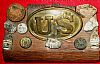
Fantastic Early Gettysburg Relic Desk Set
Click to Enlarge |
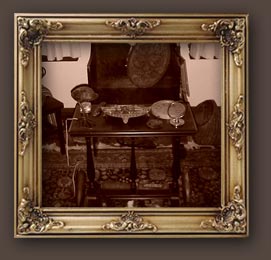
Relics from battlefields have been collected and sold to veterans and history buffs since just after the Civil War ended. Many GAR and UCV Veteran Reunions of the late Nineteeth and Early Twentieth Century saw thousands of old soldiers and their families returning to sites of youthful battles. Many wanted souvenirs. And local businessmen supplied them. As the vets died off, their children and finally modern history buffs still sought such items. Desk sets have always been popular. In the "early days" it was not difficult to still get plates and Confederate buttons for such sets. In fact, they simply nailed the items down to a wooden base! We would be more careful now... This great desk set of relics from the Gettysburg Battlefield was likely assembled and sold to the tourist trade in the early part of the Twentieth Century. Not only does it have shell fragments and a Union soldier's "US" beltplate, but a rare Confederate "droop wing" eagle button.
Tennessee Vet writes another Old Reb in 1904
Click to Enlarge |
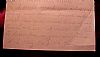
This is an interesting letter sent from W.S. Ray of Co. I 154-th Tennessee Confederate Regt. to a Mr. W.S. Stanley in Marion, VA. in February 1904. He tells what he knows of the remaining old Vets. Has envelope with both men's names and 1904 postmark- two cent stamp. Written legibly in pencil. The text follows: "DeQueen, Ark. 2-20-04. Mr. W.S. Staley, Marion, VA. Dear Sir you will doubtless think strange upon receipt of this letter so I will explain: I saw your request in February Veteran asking for more experiences of members of 154 regt. Ten. Vols. I cannot place you but it seems like a dream to me that I remember your name. I was a member of Co. I 154 then. Cross was our first Capt. then Tony Bartlett. Charley Wharton our third and last. I am always glad to meet or hear from any of the old regt. but they have most all crossed over the river. Dick Wharton of Co. I is in Mass. Capt. Geo. Melush of the Hickorys is in dallas texas. John Lynn is at Honey Grove Texas. Nat Reaves is in the soldiers' home in Texas. Were you with the army in Georgia and on Hood's Tenn. raid? I was left on the wayside sick on Hood's raid. Got able to get back to west Tenn (Purdy), joined Forrest and was paroled at Corinth, Miss May 15th. Come to western Ark. soon after and have lived here ever since. I am always glad to meet an old Confederate Veteran and especially glad to hear of any of our old Command. We have a Confederate Camp here of about 60 members. we have lost 19 by death in 4 years which will forcibly remind us that we will soon pass over the river to meet the Majority of our Comrades gone before. I will mail you a Copy of one of our town papers which will give you some idea of our town & c. I will be glad to hear from you anytime. W.S.Ray Co. I. 154 Tenn.
1868 Grant Presidential Coin Token
Click to Enlarge |
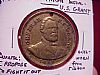
This is a cool brass coin token dated 1868 that portrays General Ulysses S. Grant in uniform for his Presidential bid. It has a hole in it for attaching to a neck ribbon or a coat.
The back quotes his military proclaimation during CW: "I promise to fight it out on this line if it takes all summer." Has some dings to edges and moderate wear from handling.
Tuck Series GAR Veterans Postcard
Click to Enlarge |
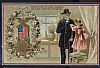
In the Early 1900's, CW Veteran were in their old age. They were very tight-knit groups, visiting old battle sites for reunions and appears at many public events in unions. They loved sending colorful postcards honoring their sacrifices and victory at preserving the Union. This item is a colorful Tuck Series lithographic Civil War postcard showing an aging CW Veteran in a pretty living room while his grand-daughter pins his GAR Star Badge onto his parade coat. Card reads: "Wreaths for the living conqueror and glory's meed for the perished." It was mailed to Wisconsin in 1913. (Fifty years after Gettysburg!)
First Maine Cavalry Reunion Ticket

Click to Enlarge |
This is an entry ticket for the 23rd Annual Reunion of the First Maine Cavalry on August 9th, 1894 at the Hotel Hesselton in Showhegan, Maine. For many decades after the war, lavish evenings rife with speeches, food, entertainment and inspired conversation took place throughout both the North and South.
Victorian Souvenir Pin of Little Round Top
Click to Enlarge |
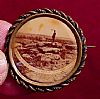
This Victorian Era Souvenir Pin bought by Veterans, Soldier's Relatives and Tourists when visiting the famed Gettysburg battlefields. It shows a photograph of General Warren's Statue atop Little Round Top. It is 1 1/2", has a nice brass braid border and intact pin on back.
Two CW and One IW Discharges for NY Trooper
Click to Enlarge |
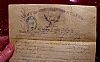
Many troops decided to carry-on for a career in the Miliary after the Civil War ended. However, the size of the army was greatly reduced and only the cream-of-the-crop were encouraged to stay. The Indian Wars of the Great Plains and Southwest were on the immediate horizon. Uniform and weapons evolved significantly, but the troops remained much the same patriotic, determined, gritty men. This soldier, Levi Storring, a farmer in his Thirties from Herkermer County, New York, went onto serving in Federal armed forces after the Civil War. His Eagle Discharges demonstrate the evolution of his military career. In a grouping of papers, we obtained his: a) "prototype" Eagle discharge from 1862; b) the more-common Eagle discharge from 1865,and finally, (c) a really neat discharge from 1869 on an onion-skin-like vellum. An 1890 pension form with $30 of payment coupons still inside topped-off the lot. Ultimately, General George Custer was massacred in the 1870's by a superior Native American force due to his arrogance and poor-assesment of his enemy's true skills.
Old Relic: Bullet from Ft. Sullivan M.D.
Click to Enlarge |
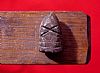
This is typical of the very basic relic "souveniers" that were sold to Vets during the post-War period at CW many battle sites. Marked on back from May 1901, this minie ball is nailed to a piece of varnished oak and marked "Fort Sullivan M.D. Heights." There is a "10 cts" tag on bacxk too... (don't you wish!) Very cool!!!
1890's Gettysburg Stereocard
Click to Enlarge |
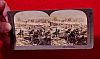
This is a late 19th Century Stereo-card viewed in a stereo-viewer to get a three-dimensional effect. It shows ng a print by the famous American lithograher L. Prang, depicting what looks like the Union side during the culmination of Picket's charge at the "Battle of Gettysburg". (It could have been "borrowed" from a period Cyclorama) Edges attest that card was "Sold only by Berry, Kelley & Chadwick/ Office: Philadelphia Studio." The image was copyrighted by Prang in 1897. Overall is: 7" by 3 1/2", with each image panel being about 3" by 3". Stereo-viewers were popular entertainment in Victorian drawing rooms before their were radios, TV's and other modern ways to distract, amuse and communicate.
Small GAR Parade Flag
Click to Enlarge |
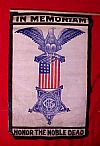
This small flag shows the GAR Star Medal with the mottos: "In Memorium" and "Honor the Noble Dead". It measures 14 1/2" by 22 1/2," comes on its original wooden stick and is printed in colors on a white cotton fabric. It was likely used in township parades by spectators during the circa 1910 period as it was found along with a 46-Star US Flag. Many Vets were in their 80's by then and memorial parades for their passing comrads quite common.
104 th New York Ladder Badge Shield.
Click to Enlarge |
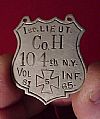
This is the shield from a post-WAr GAR ladder badge worn to GAR functions, events and parades. Has makers' names on back. By reviewing C.W. Data Bank files, it could only have belonged to two men who served as First Lieutenants in Co. H and also survived the war: Either Joseph Cary or Ephraim B. Wheeler. The 104th was a hard fighting unit with battle losses at Antietem and Gettysburg. Here is a synopsis: This regiment, known as the Wadsworth Guards, or the Livingston county regiment, was recruited in the counties of Albany,
Genesee, Livingston, Monroe, Rensselaer and Steuben. The regiment left the state on March 22, 1862,
and served for some weeks in Gen. Wadsworth's command in the District of Washington. As a part of the 3d corps, it was in action for the first time at Cedar mountain, but about a week later it was assigned to the 1st brigade, 2nd division, 1st corps, and moved on Pope's Virginia campaign being engaged at Rappahannock Station, Thoroughfare gap, Bull Run, and Little River turnpike, with a
loss during the campaign of 89 killed, wounded and missing. Lieut. John P. Rudd who fell at Bull Run, was the first man of the regiment to be killed. In September the 104th moved on the Maryland campaign under Gen. McClellan; fought at South
Mountain, and lost 82 in killed, wounded and missing at Antietam, where the 1st corps, under Gen. Hooker, opened the battle. At Fredericksburg it lost 52 killed, wounded and missing; was in reserve at Chancellorsville; was heavily engaged at Gettysburg, where it lost 194 in killed, wounded and missing;
engaged without loss in the Mine Run campaign, the last campaign of the old 1st corps. In March, 1864, it was assigned to the 5th corps, with which it continued during the remainder of the war. It took part in all the bloody battles of the Wilderness campaign, losing heavily at Spottsylvania the first assaults on Petersburg, and at the Weldon railroad. After Aug., 1864, it
performed provost guard duty with its corps, and served with slight loss through the final battles of the war, ending with Lee's surrender at Appomattox. It was mustered out under Col. Strang, at Washington D. C.,
July 17, 1865, having lost during its term of service 5 officers and 85 enlisted men killed and mortally wounded; 2 officers and 145 enlisted men by disease and other causes, a
total of 237.
1910 GAR Medal from Manhein, Pa.
Click to Enlarge |
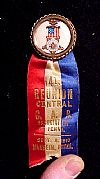
This item is very typical of the local medals, ribbons, and pinbacks created for the GAR Veterans meetings, picnics, and conventions. Having a celluloid insertion in the upper wreath medallion, which shows the GAR star medal that was the Union Veterans' logo. This device appeared at EVERY public event from 1870 through about 1940 in the North. (The South had the U.C.V. instead, the United Confederate Veterans.) The ribbon is printed in the typical red, white & blue, and announces the "14th Reunion (of the) Central G.A.R. Association of Penna./ September 8, 1910 Manheim, Penna." Very nice condition to the celluloid and bright colors preserved upon the ribbon too.
Stereoview Confederate Monument on Seminary Ridge
Click to Enlarge |
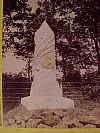
After the Civil War, thousands of ornate monuments were erected at battlesites by the men who survived. This was particularly true at Gettysburg which held a highly-honored mystique in the minds of Americans as a pivotal battle indicative of the bravery of men yet the sheer horrors of war. Photography studios made a fantastic living selling their images to Veteran tourists and their children. But besides photographs, a tourist industry of relics, clothing, paperweights, ashtrays, goblets, flags and other knick-knacks sprang up in the shops which soon surrounded larger battle sites. This image shows a Mississippi Regimental monument on Seminary Ridge. It was from there that the fateful advance by the Confederates on Day Three of Gettysburg, called "Pickett's Charge" began. Most men who walked clear of those trees in proud ranks that day never walked back. Published by Webster & Albee, Rochester, NY, probably from the 1905-1915 era.
Bayonet Candleabra
Click to Enlarge |
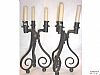
Many weapons of war were brought home as souvenirs by troops, but none were so odd as tables, umbrella stands, coat racks and candleabra made from rifles, swords and bayonets. Here is an example of three bayonets artistically twisted and conjoined into a fancy candleabra. Desk sets and inkwells were commonly created using buttons, bullets and grapeshot cannonballs plucked from recent ballefields by savy collectors and entrepeneurs.
Postcard of Meade at Gettysburg
Click to Enlarge |
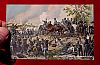
A Photochrom postcard of Union General Meade with his staff during the Battle of Gettysburg. From the early 1900's as evidenced by the need for only "one cent" postage. After the failure of Picket's advance through open fields on Day Three, the Confederate forces were severely reduced in both military power and zeal. The Civil War became a chess match that seemed to be stalling the inevitable. Yet the excellent strategies of Robert E. Lee and his regional commanders thwarted any quick or easy victory by the Union armies pouring South. The common Confederate foot soldier was not so common, having spirit, guts and a tremendous endurance based on a fervent hope for triumph. This is an unused postcard. Visitors have continued to frequent the Gettysburg battlefield and surrounding shoppes ever since the 1863 battle. Sending colorful postcards home that are postmarked "Gettysburg" is still a very common practice.
Veterans Slouch Hat Shaped Ashtray of the GAR
Click to Enlarge |
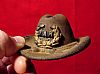
This is very attractive and interesting item. A cast-iron GAR slouch-hat ash tray from after the Civil War. The logo of the manufacturer and "Pat. Pending" can be found on the inside of the crown. The casting is superb with a great design and attention to detail. Most people smoked cigarettes or cigars in the hundred years which followed the Civil War. So an ashtray in this shape would have been a great home accessory or gift for a military dad or granddad. Measures 4" long and about 1 5/8" high at dome.
General Grant Trade Card
Click to Enlarge |
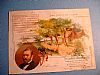
For decades after the Civil War ended, soldiers from both side admired the noble spirits of their deceased heroes and leaders. This colorful lithographic "trade card" was likely given out free in the late 1800's or early 1900's... There were similar patriotic momentoes given by Southern business that depicted Robert E. Lee and Stonewall Jackson among others...
Ladies of the Gar Gold Plated lapel pin
Click to Enlarge |
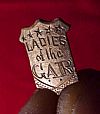
This is a custom-made gold-plated lapel pin for the "Ladies of the GAR" whicvh was most probably worn to social events and official meetings. It has clearly been custom or hand-engraved by a jeweler with five starts across the top and fine decorative trim at bottom of its shield-shaped face.. Has nice workmanship and a pin upon the back. no maker's mark. Not marked as gold but sure looks like it, so probably plated.
Fancy GAR Calling-Card of Ohio Vet
Click to Enlarge |
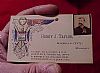
This is a business or calling-card of a Union Veteran from the 73rd Ohio and other regiments. In the corner of the card, there is affixed a small B&W albumin photo of a rather intense man with a large waxed moustache who dons his veteran's medals. The ornate patriotic graphic shows a Union flag, wreath, knapsack labeled "Scott Rifles" and weapons. It is a very cool card from a time when people were still gracious and formally polite in their social dealings. Face is only slightly age yellowed. Rear has three small glue dabs from having been in a scrap book in past. No bleed-through stains from glue. The soldier is named Henry J. Taylor.
A custom carved tree limb bearing a bullet
Click to Enlarge |
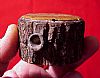
In the course of the Civil War, many trees were riddled with lead minie balls that went astray. In fact, during long & heated battles whole sections of forests were repeatedly cut-down from chipping away by thousands of bullets flying. Leading onew to wonder: How did men survive in such places? After the war, many of the trunks and limbs were collected as "War Logs" and souvenir "Bullets in Wood" for display by museums, lodges and individual troops. This item is a cross section of a tree brach which bears the exposed three-ringed back of a Union minie ball. Interestingly, the top has been polished and carved with a unique design resembling the legs of a cricket. Thus, it was used as a paperweight on the desk of either some venteran or traveler to an old battlefield as a fond momento.
GAR Re-Union Button & Medal Frame
Click to Enlarge |
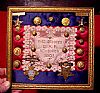
Old soldiers were very proud of their military service during the American Civil War. Of course, with each ensuing year, they were older and older, with fewer and fewer dear comrades in attendance at those yearly meetings which were so aptly called "Encampments"... Many men came together in old uniforms, or arrived in a colorful hodge-podge of newer GAR medals mixed with their original CW items... A vast array of brass, silver, celluloid and fabric items were manufactured to be purchased & worn by CW veterans at each of these group events. Upon coming home loaded with fond memories, their trunks and sachels were loaded with a notable brick-a-brack from their journies. Often, these items were lovingly incorporated into wall sets, shadow boxes, and desk items as sweetly tended momentoes. Here, we see a framed assortment of medals and buttons acquired at the 1905 Denver, Colorado Encampment by an old soldier. There are post-Civil War items from the Indian Wars period right up through the first decade of the Twentieth Century. An address label on the back of this Nouveau Period gold frame mentions a "Mrs. Edd B. Wilson" of Denver, Colorado. Was she the husband of a CW veteran named Edward B. Wilson or the married sister of a solider with another last name? There were five Edward B. Wilsons from various states who served for the Union during the Civil War. Sadly, without more information, we will never know exactly who the owner of this display was... In any case, these momentoes, set upon red and blue silk in an old frame, are a grand testament to the hundreds-of-thousands of soldiers who lived well-on into the Twentieth Century recalling their exploits and travails during the War of 1861.
1905 Denver, Colorado GAR encampment medal
Click to Enlarge |
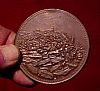
This is a 2 1/2" diameter heavy bronze commemorative medal depicting "Pike's Peak" summit on the observe and attesting to the 39-th GAR National Encampment of September 1905 in Denver, Colorado on the reverse. It salutes those "brave men who victoriously defended the Union onn land and seas during the great rebellion 1861 - 1865." A beautiful medal, now age toned with a few minor incidental nicks and dings...
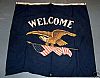
A Bold Eagle "Welcome" flag from 1890's
Click to Enlarge |
This is a 33 inch wide "Welcome" flag which bears the image of an American eagle over a 42-star US Flag. It was likely positioned in a Veterans' Hall during their regular meetings but then taken out during parades and patriotic events nearby. The 42-stars design was used from 1888-1890 but this great image could still have been used to adorn parade banners for decades afterwards. The older Civil War veterans of G.A.R. organization often marched alongside troops from the Indian Wars, the Spanish American War and World War I, so such a generic banner was a potential "town-welcome" to parading troops from all of those conflicts.
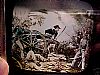
1890's Lantern Slide of Chickamauga
Click to Enlarge |
In the late Nineteenth Century, lectures were given in great halls and ampitheaters using the "lantern slide." This colorful picture or photograph was held within two panes of glass and then projected from light onto a screen for all to see. The light source was kerosene lamps and later an electric bulb. The slides were slid in-and-out by hand by the projection assistant while the speaker gave a lecture on the chosen subject. This is a colorful lithographic drawing of the Battle of Chickamauga. It shows a Union commander charging past a cannon toward a force of Confederates. Slide size is 4" by 3 1/4".
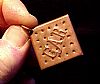
A Brass Piece of Hardtack!!!
Click to Enlarge |
This is a very cool GAR Souvenir badge from a post Civil War veteran reunion in Kentucky! It is a thick cast piece of bronze in the exact image of a piece of "hardtack," that hard biscuit that was supplied to ravenous troops during the war... it was both savoreed when starving, and then, reviled with disgust... when still starving! It was hard, brittle, had no taste and never improved from one meal to the next... No wonder troops on both sides would raid fields, barnsyards and kitchens for anything else to eat before facing their last deadly battle! Some citizens made a good living selling vegatables, eggs, meats & preserves to passing armies from both sides. Better to sell your foodstuffs than to have them "confiscated." And many a young gal met her future husband while serving up such vittles... And they were not always on the same side! Yet they "joined forces" as the Nation reconstructed after the War... Hopefully, dinner was more than water and hardtack. 1 1/4" square with a ring for hanging on coat.
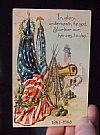
Decoration Day postcard to Grandpa c. 1910
Click to Enlarge |
This is a colorful Raphael Tuck "Decoration Day" postcard sent with a chatty family note done in pencil "To Grandpa and Grandma from Norma." It came along with two similar postcards by famed cardmaker Tuck, dated 1908 and 1910, being delivered to an Ohio Veteran named Alexander J. Keppler. By then, the old fellow resided in the Soldier's Home, Hospital Ward No. 2, Dayton, Ohio. Compared to the other two cards from a Faire Elliot, this one likely was sent from a younger direct relative and saved along with other cards by old Alexander. No stamp or postmark is on the back of this, as the note explains it was "sent along with Momma" on her visit out. It has slight edge dings. Overall in very nice shape. Interestingly, there are custom-applied gold sparkles on flag edges and cannon. Still colorful!
1906 Veterans United
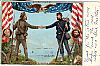
Click to Enlarge |
It is most interesting how the old animosities and wounds of the Civil War ultimately healed as the men aged and the United States faced outside enemies. This colorful lithographic postcard from 1906 shows a Confederate and Union soldiers shaking hands with inserts of Gen'ls Lee & Grant to either side. It was "For Sale by Veteran Art Co. Minneapolis, Minn" An ink inscription from sender reads "Hurrah for the stars and stripes and the red white and blue. Mother." Sent from Minneapolis by Alma Ray Fischer to Miss Jesse M. Gibbs, 6 Temple Court, Los Angeles, Cal.
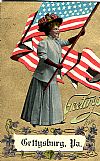
Fabulous Gettysburg Tourist Card
Click to Enlarge |
This is a fabulous tourist card printed by TH.E.L. Theochrom of Germany for Gettysburg tourist trade in Victorian times. It shows a photo of a woman waving an American flag with "Gettysburg, PA." in a banner at bottom. Unused. Very unusual item with great colors and "gold leaf" background.
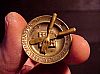
1892 GAR Medal: A plate, utensils, hardtack
Click to Enlarge |
What could endear the heart of old soldiers better than a medal that shows that terrible biscuit called "hardtack" that they were supplied during the Civil War. Some later said these cracker-like snacks were like little bricks of tasteless cardboard that nearly broke one's teeth. Soldiers tried everything to get them down~ soaking in coffee, water and frying them in bacon grease. Probably some got mad enuff to use them for target practice (they were only about 2 1/2 inches afterall... would make a great bullseye!) But most soldiers ate them simply because they were hungry and had nothing else in the field. Now, thirty years later in 1892, old men at the Washington, D.C. National GAR encampment probably got a big kick out of seeing this brass medal upon the coats of old comrads: enthusiastically telling their children and grandpups about the pain of devouring such literal foodstuff rockcandy! This medal is finely crafted brass assembled from two pieces. The tin plate, knife and fork desisna are true to their forms during the CW era. Civil War soldiers from both sides had good temperaments and senses of humor in the twilight of their lives!
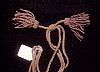
Civil War Veterans Corps Hat Cord
Click to Enlarge |
Civil War Period Hat cord used on Hardee hats of infantry & artillery as well as the slouch hats of cavalrymen to denote their branch of service. This light gray indicated assignment to the Veterans Corps in which injured and debilitated soldiers still could serve in non-combatant roles during the course of the Civil War. This was likely issued and actually used for it has a thread-reinforcing repair along the large side hat loop. The tassels are in great shape. Such hat cords were not much saved after the Civil War and thus are a bit hard to find these days.
Cut Cranberry Glass Cup
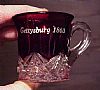
Click to Enlarge |
This type of fancy etched cranberry glass was used as souvenirs durting the 1890 to 1915 period for most big tourist spots, such as Niagra Falls, Altanic City, etc. This small cup is in quite excellent condition. Likely brought home from a family vacation to the old battlefield town near the turn of the century. It reads "Gettysburg 1863" in cranberry color. There is ornate molded design patterns at base. Nice! 2 1/2" high and 2 3/8" wide at mouth.
Abraham Lincoln Political & Patriotic Envelope
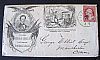
Click to Enlarge |
This is a Civil War period envelope that celebrates Abraham Lincoln and his vice president who led the Union during the conflict. The graphics are very well drawn and spaced upon the cover. A CW period three cent stamp is on the corner. During the CW there were no automatic postal machines to cancel stamps. All stamps were hand-cancelled by postmasters using crude ink stampers. Such letters could be civilian gossip, business, little love notes, or sadly news of men lost at war...
Post Civil War Relic Desk Displays
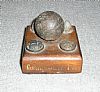
Click to Enlarge |
Many businesses in the late Nineteenth- and Early Twentieth Century catered to tourist trade of CW veterans and their children by selling desk displays that mixed old buttons, bullets and cannonballs. They often came from famed battlesites like Gettysburg or Antietam. This is one such wooden base with attached war relics. Because these items were still common, the maker simply put nails through the coat buttons to hold them down to the wood!
Voted into the Veterans Group or Black Balled Out?
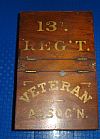
Click to Enlarge |
This is a Nineteenth Century "Ballot Box" as used by Fraternal Organizations like the Masons & Elks and, as we see here, also used by GAR Veteran's Units of the Civil War to vote on important issues secretly. Use of these boxes coined the old phrase that one is being "black balled" or voted out. The current members put either a white clay marble for yes, or the dreaded black marble for "NO!" into the opening in the box during a pass around vote. The new applicant then sweats it out as each marble is removed one-by-one. If he is voted out, he never quite knows who stuck it to him! This box has nice old gold paint letters on the lid: "13th Veteran Reg't Assoc." The person I acquired it from believes it is from the 13th Ohio due to where it surfaced on the antiques market. If you look inside, you see two compartments connected by a fancy channel. 9 1/4" by 5 3/4" by5" high. Looks like walnut or chestnut to me.
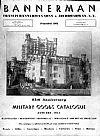
Bannerman's Military Supply House Catalog
Click to Enlarge |
Mr. Francis Bannerman started Military Catalog in 1872 and started rapidly expanding. By late 1890's he needed a lot of room, so bought Polopel Island in Hudson River near NYC and built huge Castle. It became Bannerman's Island and operated until it burned to ground in mid Twentieth Century. They say the walls were reinfoced with bayonets and musket iron from CW, it was so cheap to get such surplus items from US Government! I have heard "stories" of collectors paddling out to burned-out shell of castle and finding huge heaps of rusting miltary surplus. Frankly, I am not sure what lies out there anymore in the Hudson at Bannerman's Island. But facts remain: Many surplus Civil War insignia, shells, uniforms came to us by way of purchaes made from Bannerman's surplus military store for fifty years.
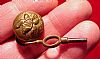
Vets Pocket Watch Key and Infantry Button
Click to Enlarge |
Veterans were proud of their service in CW. Went to many parades and events. This Union infantryman kept one of his General Service buttons on a ring with his watch key, likely just hanging from a vest pocket. Cool original combo from the past!
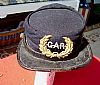
GAR Kepi with GAR buttons and Wreath Insignia
Click to Enlarge |
This is a very nice condition kepi that was used by former troops during GAR meetings and veterans parades for decades after the end of the Civil War. Many of these wore out or were devoured in closets by moths over the ensuing years. This one survived nearly intact with vibrant blue wool color. It still has the standard GAR wreath on front, as well as two GAR buttons on the sides. It was made by Kaufmanns, a private uniform supplier out of Pitssburg, PA.
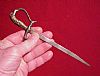
1899 GAR Reunion Letter Opener Philadelphia
Click to Enlarge |
This is a cool metal letter opener in the shape of an eaglehead sword. It is stamped in blade to commemorate the GAR National Encampment Meeting in Philadelphia in 1899. A cool item that some old soldier brought home as a practical souvenir for his desk. About 8 inches long.
1864 Philadelphia Sanitary Fair Bronze Medal
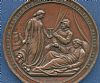
Click to Enlarge |
The Philadelphia Great Central Fair was the largest of several sanitary fairs held to raise money for the care of Union soldiers wounded during the Civil War. Only 901 of these beautifully designed bronze medals were sold. Done by Paquet. 67 milimeters.
Mottos read: "WE GIVE OUR WEALTH FOR THOSE WHO GIVE THEIR HEALTH FOR US"
"IN COMMEMORATION OF THE GREAT CENTRAL FAIR FOR THE U.S. SANITARY COMMISSION HELD AT PHILADELPHIA JUNE 1864"
Handmade Cat Civil war Soldiers in Gettysburg
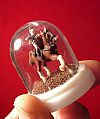
Click to Enlarge |
This is a hand-sculpted Confederate Cavalry Officer CAT on a horse with his saber drawn! Under a 2" tall plastic display dome. From the super-fun Gettysburg shop "Civil War Tails" where hundreds of hand-made Yankee & Rebel CAT soldiers pour across dioramas in battles! Great for kids. BUT I LIKED IT LIKE A KID TOO! This is my item, but look them up at www.civilwartails.com for many more!
|