Leather CW Period Drumstick Holder
Click to Enlarge |
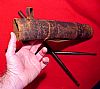
This is an interesting item! A leather carrying pouch for drumsticks, measuring 14" long with a 2 1/2" diameter mouth and leather base plug in the same construction as pouches and holsters from CW period. It has a broken stap that likely held it to a belt. Also, it has a leaf-border design tooled into leather at top and bottom of shaft.
Civil War Bugle, Seven Days Battle near Richmond
Click to Enlarge |
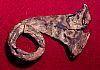
This very interesting relic comes from an old collection. Immediately after the Civil War many items were simply picked off of the ground by hobbyists. But after a time, the only remaining items had been buried underground by the action of battle or simply by time during the passing years. In most locations, Civil War relics now lie about 2-6 inches underground due to accumulation of leaves and debris over 140 years... The advent of metal detectors just after World War Two greatly assissted in the location and recovery of metalic Civil War relics. These earliest Relic Hunters discovered a vast wealth of items. Thus, these "old collections" often yield some of the most interesting examples of military goods. For instance, in this case, we see a small brass bugle, only 6 3/4" by 5", which was squashed nearly flat. It came from the Seven Days Battle Area near Richmond. It is missing part of tubing that goes back to mouthpiece, but bell and coil are present. Though a bit gnarled and split in places, it is quite sturdy. And being from an established collection it has the honor of being shown in Howard Crouch's book "Civil War Artifacts" on page 37. Who knows how it was lost and why it was crushed. Was it pounded by the feet of fleeing troops, advancing armies, hoardes of cavalry or the wheels of wagon and cannon. Time knows...we can only imagine.
Ivory Ended Ebony Bass Drum Beater

Click to Enlarge |
This is a difficult item to locate: a base drum beater. With its shaft made of fine ebony and end-knobs of slick ivory, it is quite a beauty! The larger Regimental bands tended to have many more instruments in their ensemble than the "forward" fighting regiments. These Corps Bands often performed at events for generals, family members and visiting dignitaries. The better bands were kept out of harm's way by being stationed at larger camps to the rear. Their proud Commanders often showed them off and doted upon them. This item is about 14" long.
Civil War Fife with name of Soldier carved into It
Click to Enlarge |
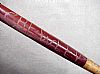
The name of a soldier-musician was carved into the rosewood of this Civil War period fife. While some Civil War regiments had huge, highly-appointed bands, including fancy uniforms and varied instruments, most depended upon the drummer and fife player to keep up a good beat and basic melody on the march. While some bands were kept in safe reserve for their admiring generals, many musician strode in dangerous battle lines beside their fellow troopers. A story told many years later by a Confederate soldier who survived the hellish Picket's Charge tells how a young drummer boy disintegrated at the point-blank blast of a Union cannon "like a smashed ripe tomato!" Being a musician was not always so safe. In the Civil War, you caught bullets rather than groupies...
No MTV or Downloading....
Click to Enlarge |
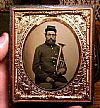
Musicians often marched into battle alongside the fighting men... inspiring them by adding a last-lift to the steps of the imminently doomed. But these players carried brass instruments rather than brass bullet-casings for mean carbine rifles. How strange that the actors, poets and musicians of that generation could still apply their abilities to a "softer side" beside the harshness of War... This tells us that men must still be men in spite of their warfare. Thy must write long love letters to their sweethearts, smoke pipes and chat around campfires while singing warmly together on those evenings just before the shrill screams of blind battle... So much is obvious during War that men can not simply step back to see... Yet the musician still hopes they can hear his angel's call...
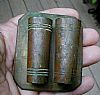
Civil War Drum Stick Holder Chest Plate
Click to Enlarge |
This brass plate was worn on the cross chest strap of a drummer who could store his large ebony drumsticks in the sleeves between songs. They are not very common. 3" by 2 1/2".
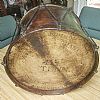
Battles Marked Drum of the 41 st Tennessee
Click to Enlarge |
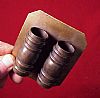
Large Brass Cross Belt Plate Drumstick Holder
Click to Enlarge |
This is a heavy, finely cast brass plate for attachment by hooks to the soldier's cross-chest strap. The heavy rear hooks are present and intact. The stick tubes are likely for larger base-drum sticks from the CW era. No maker's markings. And awesome museum-quality piece! Base plate is 3 1/2" by 3".
|