CDV: Young Atlanta Belle
Click to Enlarge |
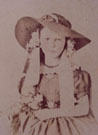
A lovely young girl splendidly dressed in her Civil War period best!
The type of child who witnessed the siege of Southern cities, burning of plantations, as well as the upheavel of her entire culture. Bears an Atlanta backmark.
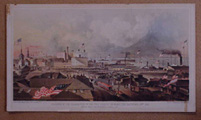
Civil War Chromolithograph of Fire Zouaves Embarking from New York City, 1861.
Click to Enlarge |
A very colorful chromolithograph by Sarony,Major & Knapp of N.Y. for D.T.Valentine's Manual of NYC (1862). Shows the rather festive patriotic parages had for departing regiments from New York in early war period of April '61. Size: 11 1/2" x 6 1/2". Few creases & glued to board. (Of course, anyone who has seen the movie "Gangs of New York" might realize some hard facts of life that are missing from this story...)
Beautiful Oil of Young Girl 1845-65 Period.

Click to Enlarge |
This is a very lovely oil on canvas of young girl from the Civil War period. Her blonde locks are arranged in the common-style called bottle-curls. It is a subtle work in both method and feeling. With no frame at 24 inches by 20 inches, it was found in Maine. This young lady certainly had relatives who went off to fight in the Civil War. Who knows~ her father could conceivably have been with Chamberlain and the 20th Maine up on Little Round Top!
Hand Forged United States Revolutionary War Bayonet
Click to Enlarge |
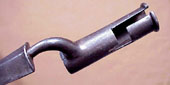
Revolutionary War American Made with tell-tale crude blacksmithing as to rolled socket, applied rim, and assymmetric sides to base of blade. Very nice shape. One open area at seam where socket was annealed closed. 19" long with 14 5/8" blade. Was this the one Mel Gibson used at the end of "The Patriot"?
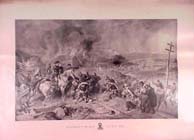
1883 Large Folio Print of: SHERMAN'S MARCH TO THE SEA
Click to Enlarge |
This is a very large sheet in black and white lithography with a central image size of roughly 28" x 20", inluding the title and vignette of Sherman's face at the bottom. It shows Sherman on his horse surveying the countryside through a telescope as his troops tear up rails and burn everything in sight. Some freed blacks move past along the rails. Quite a nice, large impressive 19th Century sheet in very fine shape.
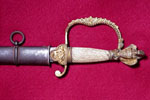
1818-1835 Eagle Sword by Christopher Giffing
Click to Enlarge |
This is a wonderful American Militia sword made by New York silversmith Christopher Giffing, active 1815-1835. Look at that perched eagle holding a US Shield on the pommel. Has a bone grip and steel scabbard. Very ornate work to all of the devices. These swords were much more ornate and individually-crafted than those mass-produced at a high-pace for the huge armies of the Civil War.
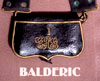
Exceptional Officer's Baldric Cartridge Box
Click to Enlarge |
This is a beautiful Officer's Dress Baldric Cartridge box, worn from 1840-65. Shown in Lord's great Civil War treatise, Vol.I, page 6. This is both stunning in design and embellishment: Deep black leather that is not cracked or flaking; the box is just over 6 inches across, with a gothic scroll insignia "GHG" and brass "1" Regimental number on outside of flap. The box is maker-marked "J.H. Mc Kennet, New York" on underside flap. The sides of box are constructed of sturdy brass endplates linked to brass mount-loops at end of the sling. The leather of shoulder sling is dark black, solid and fairly supple (no cracking). Upon sling are mounted the brass lion face, bearing two of the three original brass chains which attach decoratively to a brass shield bearing an eagle. The adjusting buckle uses tension tongs at back. When the Civil War began, some of these fancier items of prior generations went to war, but soon, they were found to be too cumbersome and gaudy for battle. In a line of potential tragets facing the enemy, one might do better NOT to stand out as something showy or interesting! Plain leather cartridge boxes replaced these, and eventually shiny metal decorative embellishments that made good targets disappeared as well.
Eagle Head Militia Sword: 1830-50

Click to Enlarge |
This is a wonderful Eagle-Head Militia sword from the 1830-1850 period. Look at that eagle head pommel which comes down as a backstrap behind the carved bone grip! The langet is very snazzy and ornate, but the quillions (cross handles) are a unique, stacked-ball design. Blade shows traces of bluing and patriotic engravings. Comes in a plain steel scabbard with a tapered drag. The Civil War was a conflict caught at a cross-roads between two worlds in collision: the Old World of Gentleman Warriors and the New World of Efficient Mass Destruction. Rifles were now more precise than muskets; cannons fired precision shells; grenades, torpedoes and iron-clads were making their first appearances; and swords were giving way to repeating carbines. When the Civil War began, the Eagle Head Swords were only a generation old, and yet, they represented a culture fast disappearing. Soon gallant men riding horses would be no more. As warfare evolved and lost all semblance of graciousness, the Eagle Head sword would become a sad forefather to the land mine, the machine gun, the helicopter and eventually the cruise missle...
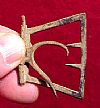
Dug Colonial-Period Buckle
Click to Enlarge |
This very interesting small Colonial shoebuckle dating from the 1700's in Ameri8ca. It was recovered from private property in the Winchester, Virginia area. When metal detecting for Civil War items, the relic hunter often will stumble upon items from before and after that War. This small and attractive item is one such coincidental discovery. Remember to nly "hunt" on private lands with the true owner's direct permnission. Be respectful~ be careful~ and neatly refill all of the holes that you dig.
Scarlett O'Hara's Green Velvet Fan!!!

Click to Enlarge |
This is a typical CW Period folding lady's fan which is coated in a lovely light green velvet, reminding me of that green velvet dress that Scarlett O'Hara made our of her curtains to see Rhet in prison during "Gone With the Wind." When fully opened, it reveals a black & white patterned paper fan. Some people call these "mourning fans" which might well be the case for the all-black examples, but this design was a common-place lady's accessory, going to dances, the theater, picnics, dinner-parties, and practically any occasion held during hot summer days and nights...
Revolutionary War: Lake Champlain 2 3/8 Inch Solid Shot
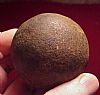
Click to Enlarge |
A number of 2 pound solid shot (2 3/8"diameter) were found in the potatoe cellar of a collapsed stone warehouse in Mount Indepence, NY along Lake Champlain. Research tells us that these came off the Schooner Liberty and were intended for one of General Benedict Arnold's gondolas being prepared to meet the British fleet. Never used and then left stored for over 200 years!
1850 Parke's Farmer's and Mechanic's Arithmetic
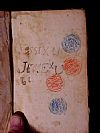
Click to Enlarge |
This book of arithmetic has various notations on the inside leaves by "Jesse Utz" from 1862 & 1867. He also rubbed crayon or colored pencil over coins to get impressions of the backs of period Large Cents. It is interesting that children did that prior to the Civil War just as we all have done with paper & pencils over coins. Rubbing aluminum foil over a coil is fun too, but they didn't have that during the Civil War!
Lady Liberty for the Union: CDV
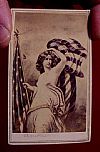
Click to Enlarge |
This is a Civil War period CDV showing a representation of Lady Liberty with a starred-crown, holding a US Flag. The image is taken from a period picture. The backmark is: S.W.Sawyer, Bangor, Maine. Nice card and image with some hand-colored accents.
Youth goes off to War!!!
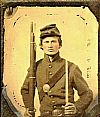
Click to Enlarge |
The youth and determination of young men is shown on the face of this Union private . What lay ahead? Would their be glory , parades, victory~ old age?~ or sad loneliness, fright, defeat and death? War has no certainty or sweet soul to it...
DUG RELICS: BEFORE & AFTER

Click to Enlarge |
A hundred and forty years later~ one might wonder how anything recognizable still comes out of the earth. But many interesting and attractive items continue to reside relatively intact just two- to twelve-inches under the soil over vast areas of the Eastern United States. The debate still rages whether to leave these items to eventually rust away completely or to retrieve them for display & study. As archeologists well-know, anything that glorifies previous cultures and individuals is not driven by bad intent but rather by warm admiration. Brass, silver and gold are still relatively well-preserved after a century-and-a-half underground... but iron objects are now quickly rusting away while wood and fabric are already gone... In this image, we see the difference in appearance of an iron Hotchkiss shell which has been cleaned of rust by the process of electrolysis and then surface-coated for future stability. No matter what side of the fence you choose in the relic-hunting debates, most would agree that we need to carefully preserve what has already come to light.
Revolutionary War Period Flint Striker
Click to Enlarge |
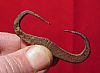
This piece of blacksmythe-forged metal was used as a flint striker to bring fortn a spark. During the Revolutionary War, firing a smooth-bore musket involved having a piece of flint srike a black powder charge which lay in a pan just outside the barrel. But by the time of the American Civil War (1861), such weapons were widely obsolete. The musket cap containing a small explosive charge of fulminate of mercury was put over a raisded opening (nipple) that took the spark down into the rifle. However, black powder was still poured down into the muzzles of rifles by the typical civil war soldier. Bullets with a bgrass casing were just being invented and were largely reserved for cavalry riders who carried carbines. Soon, soldiers would not directly "see" gunpowder again...
So Tell Me, Are They Real?
Click to Enlarge |
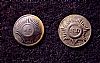
Sadly, wherever there is money to be made in this world, there are scam artists. Because of their age and sometimes rarity, original Civil War relics and weapons can cost a pretty penny to own. Over the last 50 years, unscrupulous people have often copied or reproduced Civil War items (a nice way to say they faked them) in order to deceive novice collectors who are not well-versed in subtle details and also hoping to find a bargain price... In some categories, such as buttons and buckles, the reproductions can look almost as good as the originals (in fact, sometimes they look too good!) Forgers can also artifically age the surface of new items using various chemical techniques. The old expression "Let the Buyer Beware!" is very wise in regards to purchasing Civil War items. New collectors should visit as many shops and museums as possible and learn from "old timers" who harbor a wealth of experience. This photograph shows two North Carolina Sunburst Coat buttons... one fake and one real. They both cost the buyer the exact same amount but one is not worth didley-squat! So... One must always take a real careful look and ask himself aloud "Are They Really Real?"
Young Lads in Harm's Way....
Click to Enlarge |
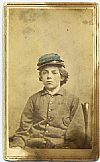
Did lads this young really go into the deadly fray of battle during the American Civil War? Well, the answer is "Yes, Indeed!" For in a Society where boys of eight worked in factories and maintained the work upon family farms after fathers fell ill... ten, twelve and fourteen were not considered too young an age to serve and even die. Such was the case with drummer boys on both sides, who often fell to musket fire or evaporated as a cannon blasted at point-blank range... In fact, ten year old Johnny Clem became a Union National Hero after his bravery at the desperate Battle of Shiloh... In the 1860's, there were no video games to test one's daring, the game of "DOOM" was played in real life conflicts that had no "reset" button.
Succession Badges down South!!!
Click to Enlarge |
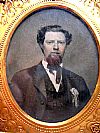
In the spirit of Southern Succession from the Union, many Southrons wore cockaded colorful "Succession Badges" that indicated their belief that a separate Southern Confederation was better than remaining with the Federal government that catered largely to Northern beliefs and lifestyles... Here is a proud gentleman that wears his belief out upon his coat for all to see! War would soon drag everyone into its cyclone!
Why do Old Soldiers Fade Away?
Click to Enlarge |
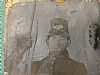
Without care and some caution, we can lose traces of mankind's past: the pyramids get buried; ancient languages become forgotten, brave men and strong women dissolve into a mist of a murky thousand years... but there are those of us who choose to preserve the memories of the evolving man and his civilizations through both written history and relics. Even ugly things like prejudice and war hold important messages about what to avoid in the future... Yet despite all our best efforts, many things are completely lost to time... Even worse yet, facts are sometimes suppressed by those who wish to change the "reality" of the past. It is therefore most important to hold onto the Truth. For it will set you free from fear, from confusion and from mistaken ignorance. In this ghost-like image an old soldier gradually disappears into oblivion as the chemicals in our modern atmosphere etch away at the chemicals from the past that once captured his proud likeness... Who was he and what did he stand for? We will never know... But let us strive to never let go of one more good man or his message... Be brave in fighting to keep and know the Truth! And Welcome, All My Friends, to the Joshua's Attic Cyber Museum. Where we join hands and hearts across time in order to unite all men through Pride, Respect and a true thorough Knowledge...
Sergeant Father with Musician Son....
Click to Enlarge |
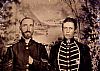
The Civil War was an odd conflict... Not just "brother" split against "brother" upon the same battlefields, but old friends from the same town watching one another die... The worst case scenarios were those in which relatives served together in regiments drawn from their local region and larger communities. Thus, a brother might be beside his cousin or brother, or a father next to his own son when fatal disaster struck. There are countless stories about fathers cradling their mortally wounded sons as the bullets still flew... or their children watching the older men who nurtured them as babes die. Too horrid for even the most stoic person to tolerate, this practice of blood relatives serving in the same unit was eliminated after World War I.... In this stunning Ambrotype, an older Union sergeant poses beside a Union musician. They appear to be father & son... ready for war... and hopefully both to return to mother if fate might choose to be kind.
Who Can Read His Future???
Click to Enlarge |
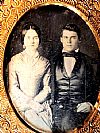
This is a daguerreotype taken before the Civil War of a young married couple: Caleb Baker Jones and Maria Bass Jones who owned the Cedar Grove Plantation in La Grange, Tennessee. Caleb Baker Jones was elected Captain at organization of Confederate States 13th Tennessee regiment. Sadly, at the battle of Murfreesboro, this same Captain Jones was severely wounded, causing him to lose a leg. His dear younger brother, John Walker Jones was killed that day. This haunting image recently surfaced on the Civil War marketplace after 140 years, being sold by Caleb's descendants. How strange for us to know of his future travails when the innocent-looking couple in this photo had no idea what was to come for them... A later tintype shows Captain Jones to have a worn, hardened look of tense severity in his face... What did his life become after the war~ with one less leg and one less sibling... Was he bitter, broken-hearted, or just plainly resolved to it?
Stand Upon their Flag...
Click to Enlarge |
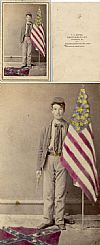
Troops on both sides would gladly die for their cause... risking existance upon their solemn oaths... and bearing anything in order to save & protect their dear Regimental Flag. In battle, most of the opposing guns were quickly directed upon the enemy's "colors" in order to incite alarm, anguish and confusion when their flag did fall. But even worse, was the loss of the flag to the enemy's possession! It was a horrible shameful thing! The majority of the men would gladly die in the process of trying to save their standard. Were it gone, the men would feel ashamed & beaten... emasculinated. And the enemy would then revel in its taking; displaying the captured flag at faires, camps and public events for many year into the future... In this CDV, a Union trooper proudly boosts an American flag aloft while grinding a captured Confederate banner into the dirt...
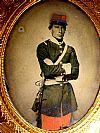
A proud and idealistic Confederate Gunner...
Click to Enlarge |
Note the confident pride upon the face of this young Confederate lad... almost noble and yet so assuredly self-righteous in his posture and demeanor... While such inner confidence might well serve a man in the heat of battle, such a raw verve might also backfire upon two opposing Peoples, sending them headlong into raw battle. Yes, there was certainly an element of that stubborn determination on BOTH sides during the American Civil War... neither party wishing to "lose face" by backing down. The end-result being ugly warfare: pain, grief and the ultimate loss of a broader view of our Humanity... Sadly, we still see that kind of arrogant stubborness in the conflicts which are lately engineered by our political and religious leaders in the world of today. But it only serves to lose our friends, brothers, sisters and the softness so needed in our deeper souls... If only men were more afraid of war.
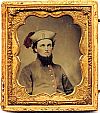
Zou Zou Zou!!!
Click to Enlarge |
Thus was the cry of the Zouave regiments as they poured across bloody cornfields, rivers an ravines to either glory or death. "Zou Zou Zou!" Those Union and Confederate forces so gloriously "custom-clad" in fancy uniforms reminiscent of the daring French soldiers of Europe. So much energy was poured into that visual "image" created by their uniforms in the bright and sparkling ranks. But they ultimately fell just as easily to a red-hot bullet at Bull Run, Chancellorsburg and Gettysburg... Men risen to a noble madness: They were ever-after renowned on both sides for fighting like crazed, inspired wild banshees! "Zou Zou Zou!" Either win or lose your life...
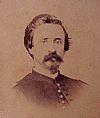
After I am gone....
Click to Enlarge |
This Civil War period CDV shows a portrait view of a bearded Union officer. There is no photographer's backmark, but a pencil inscription on back of cardboard mount card quite interestingly reads: "For Mattie Hikock after I am gone. "L.L.C." What a host of questions this raises! How was this man related to Hattie: a lover, admirer or casual acquaintance? What did this soldier mean by "when I am gone": was it when he shipped-out to war; moved across the country; or perhaps died on a far-away battlefield? Did he survive the war? Did they ever meet again? Was Hattie in possession of this card through the remainder of her life? And WHO was this soldier L.L.C. ???
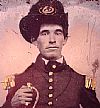
Early War Virginia Militiaman
Click to Enlarge |
Virginia Militiaman wearing "JEFF DAVIS" Hat. Hat displays a wreath encircling a large "VA" (shows in reverse on CW photos). Subject proudly adorns his uniform with belt, buckle, sash, epaulettes and holds his militia style sword. This image is from the former collection of the late Wm. A. Albaugh III and is published in his book "CONFEDERATE FACES" (1970), page 7 figure 11. He describes this photo in more detail on page 221 of his book as follows: "Ambrotype with "VA" (for Virginia) backwards on hat. Courtesy the Author. This man was probably a member of Capt W.C.Wickham`s "HANOVER TROOP", later Co. G, 4th Va Cav." SIXTH Plate Ambrotype on RUBY Glass. Photo size approx 2 3/4" x 3 1/4". Fully housed in original case approx. 3 3/16" x 3 11/16".
Goodbye and God Spare Yoiu..
Click to Enlarge |
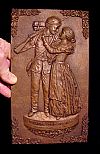
This is a small, yet heavy, bronze wall plaque showing a Union soldier in finely crafted-relief hugging his sweetheart farewell. It was a scene reenacted across both North and South throughour the Civil War. Farewell to a mother, father, children or spouse~ at docks, upon a porch, at a train platform or in the quiet front yard under the apple tree. Would he return or be a lasting memory for decades to come? People during the Civil War did not solely celebrate patriotisdm and battles won, but they also ached in their hearts over the ironies, sadness and bereft loss of war's cruel side as well. But fate is strange ~ for while some familes were torn apart, other life-long friendship and romances began because of the Civil War...
Making Bone Buttons.
Click to Enlarge |
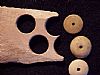
Buttons for shirts, coats and particularly men's trousers were often made from animal bone which was plentiful on farms and in stockyards. These were still used extensively during the Civil War, especially by the Southerners. A thin slice of bone was used to cut out round disks which were then smoothed at edges and pierced for threads. Such a slice of animal bone that was clearly used to make buttons is seen here~ found in a Colonial period trash pit. Examples of bone buttons, the product of such a process, are shown with it. Bone buttons are commonly found at Civil War camp and battle sites.
Daguerotype of a Fancily-clad Young Woman
Click to Enlarge |
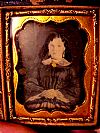
This is a 1/9th-Sized Daguerotype Plate from the 1850's era. It is printed upon an actual silvered plate, the very first form of true photographs invented. It shows a young woman adorned in black with a lace collar, a fancy hood, and pendant earrings. She is pensive and pretty. Sadly, we do not know her name or age. The image has good clarity but is slightly light or washed-out in the face. Comes in its original glass and brass mats. This is indeed a nice example of a pre- Civil War daguerotype with a rather attractive young lass as the subject. She could have been the parent, older sister or aunt of a young Civil War soldier... We might well ask ourselves: Who did she know who was later killed in the upcoming American Civil War???
Two brooches of one honored man
Click to Enlarge |
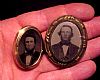
In the times prior to and during the American Civil War, fashion dictated that women often wore brass or even gold photographic brooches on their neck collars of dress fronts. The images on silver, copper or tin plates were trimmed to fit into oval and round inserts which then pinned by way of a base-housing to the clothing. In civilian times brothers, sons and husbands filled the chambers for friends and owners to gaze upon... during wartime, the same men appeared as determined & severe-looking soldiers. Lert it be said that the man worn in such a brooch was cherished in either war or peacetime. Occasionally, their name, a poem, or even a lock of hair was hidden behind the image... a most touching connection. Sadly, in the case of these two large brooches, the bearded gentleman is not identified. These came from the same pre-Civil War family collection and are indeed the same man in different formal clothes at different times in his life. He was still young enough to carry a musket in the American Civil War.
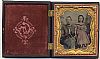
Father and Daughter... time and uncertainty
Click to Enlarge |
For each soldier lost to battle or disease on either side, someone would be left behind to ache and wonder over them. An empty chair during holidays, a lonely hunting dog, a vacant seat at table's head... And what if fate dictated that the gallant warrior fall in heated battle? He was not just a soldier but a father who would be missed with a hollow ache for an entire lifetime of "what ifs"... In this image, we see a proud father and thrilled daughter... and we wonder what occurred to them both as time and men marched on to face destiny.
Beloved Brother of Ours!

Click to Enlarge |
Men march off to war and behind are left many who worry, ache & fret on a daily basis. Will the next letter be pleasant familiar chatter from their proud brethren serving his country? ~ or will it be a letter from his commanding officer telling of his untimely death? After large battles, newspapers often published long lists of the dead & wounded based upon the local regiments involved in the fray. Citizen back home scoured these dismal lists for information. Imagine seeing the name of your brother, son or love listed as "killed"... In the days of war a "farewell" at a dock, depot or train platform might well be that "farewell till eternity"... It was not simply "see you later"... men died by the tens of thousands and ofdten were hastily buried in unmarked, unforgotten graves. This lovely ambrotype shows two sistens tenderly resting their cheeks upon the strong shoulders of their brother who was about to depart to battle. Did he return or did his loss leave a lasting hole in the hearts of these two lasses???
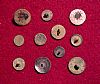
One pre Civil War Coin Button
Click to Enlarge |
Coin Buttons were plain metal buttons of various sizes that were used on a host of civilian garb such as coats, vests, cuffs and earlier breeches. They were common in Colonial & Revolutionary War America, but still used up until Civil War by civilians. Often made of brass but sometimes silver plated, some have their maker's markings on backs. Many of these buttons managed to find their way to Civil War sites on vests and overcoats which were brought as accessories to stay warm or relax. A few may have been on plain garb worn by Southern troopers who could not be issued uniforms which became in short supply later in war. Buttons for trousers were often made of animal bone or wood. Suspender clips were of brass or iron. Shoe & belt buckles either brass or iron. Therefore, quite a variety of items to be found on CW battlefields and in campsites!
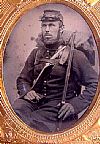
Backpack is Packed!
Click to Enlarge |
Ready to march off to war. A soldier often carried many needed "household" good in his backpack: tobacco, tea, coffee, stamps, ink, needles, thread, extra socks, mittens, a bible, and maybe photos of loved ones... When battle loomed, the entire company would put their backpacks in a bunch, hopefully watched by the Quartermaster or an attendant till they returned. Some were never reclaimed and contents were shipped back to grieving families. Occasionally, if the company needed to flee in quick retreat, all the men lost their worldly good rather than losing their lives... Eventually, learning the strain of carrying such packs over great exhausting distances, hardened "veteran" troops simply carried a few items rolled in a folded blanket across their backs.
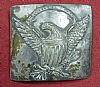
Pre Civil War Militia Eagle Buckle
Click to Enlarge |
This is a lovely silver-plated militia belt buckle from the 1830 to 1850 period. When the Civil War broke out, much heavier plates with stronger hooks were needed in order to endure the strains of field combat and the need to support many more heavy items from the soldier's waist belt. Thus, these more delicate plates were no longer used as the common heavy "US" waist belt plates were introduced for the duration of the Civil War.
Ambrotype of 1857 Drowned Lad
Click to Enlarge |
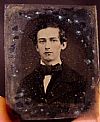
Life was amazingly different in the Eighteen Hundreds. People suffered from hunger, disease and a host of unusual accidents that we rarely see in our times. People were thrown from horses and died. People passed-away from bad food. And this shows a glass plate ambrotype image of a young lad who drowned. A note in the photo case says "My Darling Brother/ April 1857" who "drowned in the Muskinssigim River at Farmersville, Ohio."
1824 Slave & Horse Tax Receipt Wyeth County
Click to Enlarge |
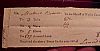
Times have changed! This is a tax receipt that was issued by the tax collector of Wythe County, Virginia, and serves as a source of proof of the origins of the Civil War.
Issued in Virginia in 1824--36 years before the start of the American Civil War, this receipt verifies that taxes were paid on human property. This historical, partly stamped document acknowledges the receipt of the grand total $5.90 in tax monies for the year 1824 for, among other things, two slaves. And a total of $2.25 in taxes for 637 acres of land!
According to the receipt, the money was received from "Mr. Michael Brown" as tax for
Mr. Brown's name, along with other figures indicating debits and credits, is also handwritten on the back--Michael Brown must have owed some change for something. The document was folded twice times.
This receipt is perfect for framing. Overall measurements are approximately 1.5" x 6.50 inches. It would make an absolutely fascinating keepsake and topic of discussion hanging on the right wall....
An interesting document from a bygone, though difficult, period in American history when men and horses were considered the same kind of property!
1857 American Express Company Receipt
Click to Enlarge |
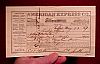
In the 1800's, packages were often moved by shipping companies such as Harden's Express and American Express. United Parcel Service today is still such a company. But during the CW, packages big & small were shipped by train or steam boat to both citizens and soldiers. It was odd that sometimes a person in the North could still send items to a relative in the South in spite of both "countries" being at war! This is an 1857 American Express Label. It has cool graphics of a train and steam boat. If you think about it, the train was only thirty years old and steam engines only about fifty! But like our modern home computers that came on board about 1990, these innovations were spread everywhere in society within decades. Mankind does not stall on using great ideas!
Cased Sixth Plate Dag of 1848 Boston Teenager
Click to Enlarge |
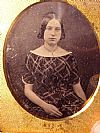
This is a Sixth Plate Dag of a pretty bt simple young girl from Boston in a geometric patterned dress. She is identified behind image as Catharine N. Sloan of Boston. Taken in 1848 on some sort of "trip." It comes in a full leatherette half case with a carmine floral pillow.
Attractive Woman Daguerrotype c 1845
Click to Enlarge |
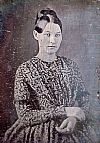
Very attractive young woman in a quite ornate patterned dress upon this silvered metal 1/6th plate Dag. Some solarization ringing aound periphery near edges of brass mat. She could have been the older sister, aunt, or even mother of an upcoming CW soldier....
War 1812 British Artillery Button from Virginia
Click to Enlarge |
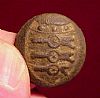
This is a cast, one-piece button showing three cannon in a shield. It comes from Virginia site in USA. But, surprisingly, it is a BRITISH button from The War of 1812.
1863 Forms Exempting NYC Fireman from Draft
Click to Enlarge |
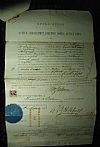
Original Civil War Signed Documents approving a Substiture sign-off to take the place for war duty for a NYC Active Fireman, who was drafted. This two page document consists of a "Voucher of Foreman and Secretary" for Hook & Ladder Co. #12, To Certify that Michael N. Salman is an active member of said Company performing active duty therein and has been drafted in the 8th Congressional District of the State of New York. Signed Sept. 5th, 1863." Another document that came with it: "Application of Active and Exempt Fireman Doing Active Duty". Signed by a notary and Certifies that, Philip Prendergast has been accepted as a Substutute for (Fireman) Michael N. Salman.
They both have a few very minor tears at folds and edges.
Currier and Ives the Pitfalls of Alcohol
Click to Enlarge |
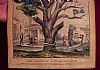
This is a very cool lithorgaph from Currier & Ives prior to Civil War. It shows the pitfalls of drunkeness, including all the sins in the tree of vice which hang like multi-colored fruits. In original walnut frame.
Black Chaplain of Colored Regiment CDV
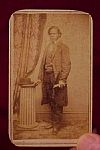
Click to Enlarge |
This is a Civil War CDV of an intense-looking black man who was a chaplain of a colored regiment. He reminds me of Frederick Douglass, which is odd because the photographer was "Mrs. Douglass" of Fulton Avenue. (probably New York) It has slightly light tonal contrast with mild foxing spots.
PreWar Officer seated with his cute tiny tot
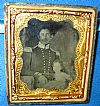
Click to Enlarge |
The 1800's were a time for stillness and formality in behavioral norms. It was also essential "to sit still" for long-exposure photographs which would blur. Taking energetic children was a challenge. But in this image, a pre-War militia soldier managed to keep his cute little toddler still on his lap. Did he threaten her with "the brig"? No ID known on this affectionate father or the smiling little angel...
Bottlecurled Intriguing Beauty
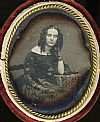
Click to Enlarge |
This stunning beauty poses with a penetrating gaze from the silvered surface of a pre-Civil War daguerreotype image. The bottle-curls were all the rage in the 1840 -1850 era, but sometimes were still worn in 1860's. Her lacy gloves and jewelry could also still be seen in CW era. No ID known on this woman. But she likely broke hearts!
Pivoting Tin Lamp from CW era Rallies and Parades
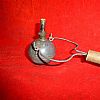
Click to Enlarge |
Many old engravings show citizens carrying these pivoting pewter & tin kerosene lanterns on tall poles at Political Events, Parades, and Rallies in the mid-Nineteenth Century. This is a nice example of one such Kerosene Street Event lamp.
|