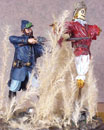
U.S.SHARPSHOOTER IN CORNFIELD
Click to Enlarge |
A U.S. Sharpshooter hidden behind a scarecrow in a cornfield; with actual dried stalks as the corn! A very cool genre scene. Resin. Size: 90mm. Hand-painted by Matthew Catania with fine attention to detail. A one-of-a-kind artwork.
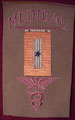
Medical Service Flag
Click to Enlarge |
A very attractive pennant of felts, and machine embroidery,
probably World War II vintage, demonstrating service in Medical Dept. A compact 9 1/2" high by 5 3/4" wide. It has been mounted in acid free mats & frame for long life!
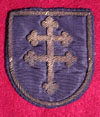
79th Division Bullion Shoulder Patch
Click to Enlarge |
Worn by the Dough Boys on their shoulders during World War I. A silver bullion Cross of Lorraine on navy blue silk. 3" x 2 3/4". Very Nice!
Spanish American War Medical Cap Insignia andcollar insignia Set.
Click to Enlarge |
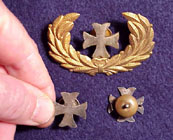
Crosses were NOT used during the Civil War, but rather the initials "M.S" for Medical Staff. But by the time of the Spanish American War in the late 1800's, the Maltese cross was being adapted for Medical Staff. This set of three insignia is for a Medical Officer during the Span-Am. War. All three pieces are screw backs, with
accessory stick pins to keep them from rotating. A kepi badge and two collar insignia.
Two Military Tickets: Military Dance & Brass Band Trip
Click to Enlarge |
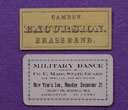
Two post Civil War tickets on thin cardboard stock. 1)Military Dance to benefit Co.C. of Mass(achusetts) State Guard (held New Years Eve); and 2)Camden Brass Band Excursion ticket.
Postwar StereoCard of Black Children with Melon
Click to Enlarge |
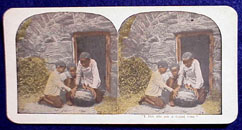
Sadly, even after Emancipation of the Slaves in 1863 and Union victory in the Civil War (1861-65) a huge amount of racial prejudice survived for generation afterward in sections of the South. Rather than slaves, blacks were cast in the light of children or vaudevillian type clowns. They were given "rights" which were forced by the vistoriuos North, but they were not given true equality and respect till the start of the Civil Rights Movements of the 1960's... This stereocard is from the 1890 to 1920 era.
WW2 Patriotic Cover: Free France Fights On
Click to Enlarge |
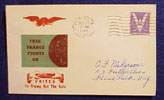
Patriotic Covers were not as common after the Civil War, but still did occur: Here we see a nice World War II (1939-1945) United States patriotic cover sent in 1943: "Free France Fights On"
and "United: to stamp out the axis". Bears a three cent "Win the War" stamp.
Fractional Currency: Ten Cents Note!
Click to Enlarge |
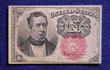
Can you believe they had paper money for "parts" of a dollar! Yes, even during the Civil War they had "fractional currencies" in both the NOrth and South. Back then a dollar could buy a LOT! Men often worked for 5, 10, 25 cents per day! This note happens to be from the decade immediately after the Civil War. But many young Veterans would've carried them in their leather billfold wallets. It shows William Meredith, Sec'Treasury in 1840. This is "Series of 1874". A small 3" by 2" in size. And you can't get these from modern MAC machines!
Patriotic WWI Lithograph Honoring Black Troops
Click to Enlarge |
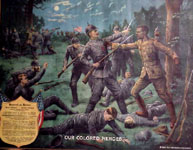
Not until World War II were black troops used extensively in the American military. Of course their were exceptions during the Civil War, as exemplified by the 54th Massachusetts in the movie "Glory!". Black troops were incorporated into fighting units mostly near the latter years of the war. They were sometimes treated harshly by the enemy, such as the bayonet massacre at Fort Pillow. During the Indian Wars, the Buffalo soldiers were a tough lot who fought the Native American war parties. During World War I, the "special treatment" of black soldiers still continued. One unit, the 371st, actually trained in South Carolina. But they were assigned like all the other Negro units, to the French Army. That unit was not allowed to march under the Stars and Stripes, but were required to use the French flag. As a result they "modified" the French flag. They added a small American flag and a red hand to the flag.
In this particular lithograph, we see Henry Johnson and a fellow soldier, Needham Roberts, who were on sentry duty when they came under attack one night in May 1918 by a 20-man German raiding party. Johnson drew his bolo knife from his belt and fought off the Germans. Despite suffering three grenade and shotgun wounds, he went to the aid of Roberts who was being taken prisoner by the enemy.
Johnson received the Croix de Guerre, one of France's highest honors, but he was never recognized by his own country because of the color of his skin. He didn't even receive the Purple Heart until 1997, despite being wounded 21 times in 1918.
The chromolithograph is from 1918 by E.G.Renesch, Chicago.
Original Oak and Canvas WW1 Field Stretcher
Click to Enlarge |
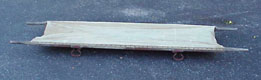
This is a spectacular piece of medical/rench history! It is
a field stretcher, which when pivoted open, sits on metal
footings. Two long solid oak rails with sturdy canvas tacked to sides. In great shape!!! About seven feet long and heavy!!! Great!!!
WWII ID'D Nurse's Army Jacket
Click to Enlarge |
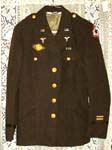
This is a tapered US Army officer's jacket in near perfect condition for 1st Lt. Velma Deuel, an Army Nurse who's cuff marks indicate she served at least 12 months in a theter of war. The ruptured duck insignia indicates she finished out World War II. In addition, her gold 1st Lt. Bars AND two "N"
(nurse) Cedeusus (Double snakes) medical lapel pins are present. Name tag inside at nape indicates "ANC" or Army Nursing Corps.
WW1 Postcard: Ready to Fire

Click to Enlarge |
The uniforms and equipment by the time World War I occurred (1914-18) were very much different than during the Civil War. But the men in the clothing were the same patriotic, idealistic and secretly-scared type of beings. Dough Boys heading toward Europe in 1917 and 1918 were often the Grandsons of Civil War Veterans.
Louisianna Series 1874 $5.00 Baby Bond

Click to Enlarge |
This is a small, attractive 1874 Louisianna State "Baby Bond". Roughly 5" x 3 3/4". Used by that state to raise funds during post Civil War period.
WWII Sterling Silver Flight Surgeon's Wings
Click to Enlarge |
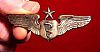
These are WWII sterling silver flight surgeons' wings by N.S.Meyer of New York. A full three inches across in nice shape!
A Scalped Lieutenant's retrieved Shoulder Boards
Click to Enlarge |
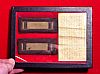
If you don't like this story, then you don't like history and should go watch TV now! These Indian Wars construction Union Cavalry First Lieutenant's straps come with an old typed note that explain their tale: In about 1875, two soldiers out of Fort Buford were trapped on a butte and fought a Sioux war party to the death. These straps were retrieved from the dead Lieutenant's uniform and given to a sutler at the fort whose descendant passed them on to me. Here's some info. about this famous Western outpost, compliments of our web visitor Ryan Houston: Fort Buford commanded the vital Missouri-Yellowstone confluence, a major link in American military strategy of the nineteenth century. Established June 13, 1866, the fort eventually housed six companies of infantry and cavalry. Its early years saw frequent actions and numerous fatalities in skirmishes with American Indians living in the area. Units stationed at the post included the 6th Inf., and the Black 10th Cavalry and 25th Infantry. Called "buffalo soldiers," African American servicemen were stationed at Ft. Buford from 1891 to 1895. The most to serve there at any one time was 282 The soldiers policed the international boundary, guarded railway construction crews and provided escorts for steamers and wagon trains. Area settlement in the 1890s ended Ft. Bufords usefulness, and it was abandoned in Oct. 1895. Fort Buford played a role in the vigorous campaign against nonreservation Indians in the mid 1870s. The fort's surgeon, George E. Lord, was among those who died with Custer at the Battle of the Little Bighorn. After the battle, the military pursued the Cheyenne and Sioux, including Sitting Bull and his followers, who went to Canada. Two years later, Sitting Bull returned to the United States at Fort Buford, formally ending his exile on July 20, 1881, at the quarters of the post's senior officer, Major David Brotherton. Sitting Bull was held prisoner at the fort and was later remanded to Fort Randall. Many famous frontier personalities are part of Fort Buford's history. Indian leaders detained as prisoners of war here included the Nez Perce Chief Joseph, Gall, Crow King, and Sitting Bull. Yellowstone Kelly, a scout, and Col. William B. Hazen were also among the residents of Fort Buford.
Flier for a Vaudevillian Show Down South
Click to Enlarge |
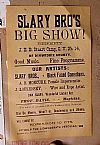
This is a small paper flier advertising the "Slary Bro's Big Show" a Vaudevillian type medley of acts put on for the Benefit of J.E.B. Stuart Camp, C.V. No. 14 of Dinwiddie County. Cost: Ten Cents to "help the Confederate Veterans." Acts featured the Slary Brothers themselves as "Black Faced Comedians," as well as a Female Impersonator, a Wire & Rope Artist, a Ladder Act, and a Magician. Printed by Kirkham & Co. in Petersburg. This illustrates the influence of the Civil WAr years later as Vaudeville evolved on stages played in the South.
Stereocard photo of Wounded WWI Troops
Click to Enlarge |
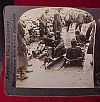
A stereoview (#119)of World War (I) from a 1921 series of 300 by the "Keystone View Company." On back it has a descriptive text. The long trench-warefare siege at Petersburg during the Civil War was only a prelude to the carnage in the trenches of Europe during World War I.
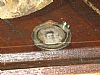
A GHOST FACE FROM WORLD WAR II BATTLEFIELD!
Click to Enlarge |
This photographic brooch of a young woman was found amongst a pile of spent machine gun bullets on the Arnhem battlefields of WWII... Coming from near an old farm called "Ommershof" which was the scene of intense fighting between British /Polish airborne divisions and the German Forces in 1944. Dubbed Operation Market Garden. Now we must wonder: Who was the young lady pictured, a sister, wife, or dancehall sweetheart? And how did this once-cherished brooch get lost amongst the deadly pile of automatic firearm casings? We are forced to ponder: Did this soldier survive the pitched & bloody conflict to see her again upon this earth? Or is he resting in a European military cemetary within those overly-long rows of white granite grave markers inscribed repeatedly as "Unknown"? How odd that her face and eyes look to us now~ as if they are still asking insistently: Why is there a thing called war which meanly robs us of our loved ones?
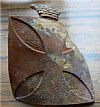
A British Chaplain's cap badge
Click to Enlarge |
This is a very rare World War One badge from a military trashpit near the fierce Ypres battlefields of Europe. Often the Medics, Orderlies, Porters, Drivers, Nurses and even good-hearted Chaplains became victims of gunfire and artillery barrages. War is sadly quite indiscriminant and wholly unfair in who it kills in its ugly deluge.
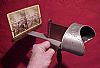
1895 PerfecScope Stereocard Viewer
Click to Enlarge |
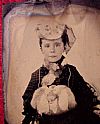
Tintype of Young Girl covered in dead furry things
Click to Enlarge |
This is an interesting 1/6-th plate tintype of a young girl from the 1865 to 1880 era. She is lovely and dressed in her best. Only problem is that Americans often liked to decorate their hats and clothes with dead animals: such as feathers from endangered birds and fur from other mammals! We see her hand muff is made up of about 4 dead mink and another is wrapped around her neck as a dainty fashion scarf! Who knows what is on her bonnet! A very cute girl from an entirely different form of American culture. These are the people who wiped out the buffalo!
Hand Sewn Known CW Veterans Testimonial from Butler PA
Click to Enlarge |
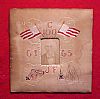
This is a framed, memorial to Pvt. Jacob Fuller, Co.C, 100 Pennsylvania Infantry. Jacob Fuller, Residence Butler County, PA. (Family history) He enlisted on 2/27/1864 as a Private. On 2/27/1864 he mustered into Company "C" of the PA 100th Infantry Regiment (just as sewn onto fabric). He was Mustered Out on 7/24/1865. Fuller died on 1/23/1910. This homemade memorial stitchery dates from about this time period. Besides his photo in center, it has sewn flags, cannon and a camp tent... The fabric & stitchery memorial measures 11” x 11” and is stretched across old backing cardboard. (No frame) In cabinet card, Fuller is shown as an older gent in civilian clothing. Cabinet card reads: "N.J. Criley, Artistic Photographer, Butler, Pa., A full line of all novelties in picture frame mouldings. Room moldings and picture hooks, mats, etc., made to order at reasonable prices. Special attention given to enlarging and finishing crayons, water colors and sepias." Some color fading and age-moisture staining to fabric but a solid item.
Tintype of Cocky Spanish American Trooper
Click to Enlarge |
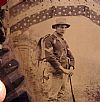
This is a 1/6-th plate tintype of a cocky looking Trooper from era of Spanish American War. Great display of equipment from that era. He stands under a patriotic-flag banner while holding his rifle non-chalantly before him. No ID known. He has that "Me and Teddy Roosevelt can kick any foreigner's butt" posture and look on his face!
Antique Wood Lantern Slide Blue Gray Shaking Hands
Click to Enlarge |
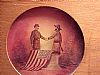
This is an original wood-framed Victorian-era Lantern Slide. It was projected upon a screen by a light, often a flame burner, behind it. It shows a colorful vignette of a Union and Confederate officer shaking hands across a grave marker draped with a US Flag. The wood holder is marked in pencil "22 Blue & Gray". Still has nice hand-applied color accents. Overall is 7" by 4".
Very Cool GAR Veterans Slouch Hat
Click to Enlarge |
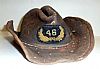
This is a very cool cavalry style "Slouch Hat" worn by a Civil War veteran to mweetings and parades.
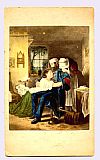
Return of the Wounded Troop CDV
Click to Enlarge |
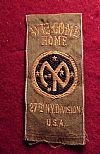
27 New York Division Welcome Home Ribbon WW1
Click to Enlarge |
This is a "Welcome Home" cloth & embroidered stickpin ribbon worn for the return from France of the New York 27 th Division. World War 1. A nice item if you like World War 1 or New York divisions. About 4 3/4" long.
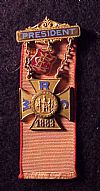
Fancy Womens Relief Corps Medal
Click to Enlarge |
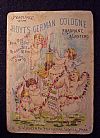
Trade Card Hoyts German Cologne 1890s
Click to Enlarge |
This is a trade card from Hoyt's German Cologne circa 1895. The back describes all its fragrant benefits at theater as well as sick rooms. cherubs frolicking in perfume spray on front.
Unused Ticket to 1955 Confederate Ball
Click to Enlarge |
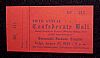
This is a very nice unused ticket to the 5 th Annual Confederate Ball held on Friday, January 21, 1955. Many people still dress in old Confederate uniforms and gowns, attending these gala events. Ticket is almost 60 years old now!
Sons of Confederate Veterans Medal
Click to Enlarge |
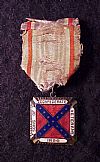
This is an enameled medal for the Sons of Confederate Veterans. It bears an "1896" date. I am told that this was the founding date of the UCV, and this medal is likely from a later Reunion Era. Based upon the ribbon and type of enameling quality, I am roughly guessing 1905-1915. Great enameling to the CSA Battle Flag. On back of medal is place for the "camp" number, which was never engraved. The Red and white ribbon is frayed and fragile. No top pin-bar.
Otstanding 19-th Century Geared Cannon Model
Click to Enlarge |
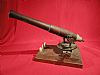
This is a great later Nineteenth-Century wood and geared display cannon. The clockwork gears turn and raise the wooden barrel when cranked. Probably a one-of-a-kind piece by a creative craftsman for himself or a Civil War veteran. The 14 1/2" wooden barrel is drilled with a 3/4" bore. It is mounted on a 9" by 5 1/2" wooden base. No maker's markings. There are three 58 caliber CW minies positioned on front of base for looks. A super, custom-crafted CW related object from 1880 to 1900 era!
Vintage Gettysburg Tourist Desk Set with Relics
Click to Enlarge |
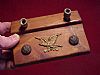
This is a very nice vintage desk set from roughly the 1930 to 1950 era. Sold to tourists visiting Gettysburg. It has two bullets, a Union minie and CSA Gardner mounted at angles to hold pens. There are two coat-sized Union General Service buttons mounted on either side of a brass eagle insignia. There is old green felt on underside, dating this to that era. The wood has super pretty grain. No maker's markings.
1929 United Confederate Veterans Medal Cockade
Click to Enlarge |
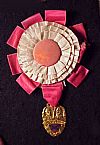
This is a totally amazing 1929 United Confederate Veterans (UCV) Red & White Silk Cockade and gold-gilted medal showing Generals Lee and Jackson in fine detail. The CSA battle flag is actually finely enameled! The manufacturer's name is raised on the rear of the medal part. The silk cockade itself survived quite well with some minor stains and sparse edge fraying. Whole thing is a big 7" tall. These were worn with true regional pride of veteran soldiers during Reunion Conventions & Events.
Amazing Civil War Widow's Dressing Mirror
Click to Enlarge |
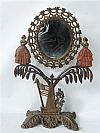
This is an amazing, post Civil War era "widows dressing mirror". It is cast iron with patriotic and memorial these, likely all in memory of a fallen past Soldier-Veteran. Ladies were proud of their soldier beaus' service. This one would peer at her own visage and still be reminded that her spouse once saw the same image when marching off to war. As always, there are motifs that reference the Union. It is a very attractive design. An uncommon piece, especially in such great condition. Thank you to: Kathleen of The Arkrite for donating this photo.
Super Engraved 15 th Corps Cavalry Badge
Click to Enlarge |
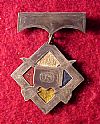
This is a super 15-th Corps badge for Cavalryman. It has engraved cartridge box and sabers. T-bar pin still on back. Multi-colored cloth in openings.
State New Jersey Honorary Medal for G.A. Holl
Click to Enlarge |
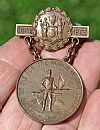
This is a fine bronze medal presented to New Jersey troops who fought in the Civil War. Medal is numbered 2543 and inscribed on back to G.A. Holl. There were two G. Holls from New Jersey during Civil War, one a sergeant and one a Lieutenant. A very cool ladder medal honoring those who served the Garden State. Not a common medal.
GAR POST calling card with Afghan Warriors
Click to Enlarge |
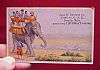
This is a colorful chromolithograph GAR calling card from the late 1800s for John H. Chipman Jr of Beverly, Massachusetts. It notes meetings are "every Thursday evening." Why he chose an elephant bearing Afghan Warrior is hard to say. Maybe he knew the trouble Afghanistan would cause in future to the West? Or it was merely exotic?
Saving the Merrimac !!!
Click to Enlarge |
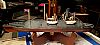
I enjoy re-building and re-painting old Aurora and Revell plastic models that were done badly years ago by kids in a rush. Well, I recently got hold of the Confederate ironclad "The Merrimac." It was badly glued, painted in a messy way, and missing almost every deck detail. So, I took it apart, tightening the body. Then, I doggedly did the best I could building missing parts. The lifeboats are hand-carved from florist foam block. The masts and support poles for lifeboats are Q-Tips! Then, went about re-painting it based upon photos on the internet. Though it is NOT historically exact, it is a heck of a LOT better than when I started. Doing the flags with magic markers and White-Out was fun... I highly recommend sitting and painting soldiers, forts or ship models to those who love history and need to relax from an overly-busy modern world.
Ladder Badge for WC Johnson 16 Missouri Cavalry
Click to Enlarge |
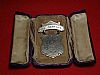
This is a lovely nickel-plated (German silver) veteran's ladder badge identified to: W.C. Johnson of Co.G, 16 th Missouri Volunteer Cavalry. The neat thing is that its original velvet presentation case is still with it after all these years. The photo is courtesy of Langham Coins in Vandalia, Illinois".
Victory Newspaper at close WW2 with Generals
Click to Enlarge |
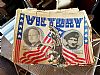
This is a colorful newspaper from the end of World War 2 celebrating Victory against Germany. It shows US General Eisenhower and British Commander Montgomery. It is neat that such awesome historical items can still be found in antiques shoppes and Co-Ops. I found this on my travels sitting on a pile of old clothes and toys!
1864 Gen. McClellan plaque for his Presidential run
Click to Enlarge |
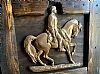
George McClellan was a rather well respected Union general who led the army prior to Grant. He ran for US President in 1864 against Lincoln, but lost. This image shows a very well executed metal plaque of a uniformed General McClellan upon his steed. These were sold in 1864 to help fund and promote his presidential run against Lincoln. The wooden mounting was added by collector later. This image was kindly donated to our Cyber Museum by: Battle Park West.
Relics from Gettysburg Battlefield of 1863 in cigar box
Click to Enlarge |
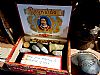
These are field pickup relics from the 1863 Battle of Gettysburg. Possibly collected by a returning Vet who strolled hills and fields where he once fought and friends died. Relic hunting occurred almost immediately after the battle ended by local citizens. Soon, local entrepreneurs collected relics to sell in shops to droves of tourists. In Twentieth Century, the fields were mostly clear of objects. After World War 2, modified mine sweepers were used to hunt underground metal items. But the practice was forbidden on National Park areas in Seventies. Most relics surface these days as old collectibles and relic sets like this one. The label is of the 1900-1945 era. The relics in this old cigar box are from a span of time, the darker bullets immediately after the conflict, and corroded items from later decades. A nice mix, attractively presented.
|