A 58 Caliber Civil War Minie-Ball Bullet
Click to Enlarge |
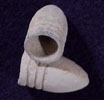
These are the common "three ring" .58 caliber "minie balls" used by the infantrymen of the Union army. They were cast by huge machines in the arsenals of the North, such as Frankford and Allegheny Arsenals of Pennsylvania. After manufacture, these lead bullets were placed in individual paper sleeves that contained a pre-measured black powder charge. In battle, the paper wrap was torn (often with the teeth), the powder-charge poured down the barrel, and then the lead slug dropped down atop that powder. When the spark from the musket cap met the waiting charge, off spun the bullet down the barrel towards its distant target. Often in the fearful disarray of battle, troopers dropped these bullets. Thus, they laid upon the ground unscathed by any impact. As such, many "drops" or unfired bullets are found with an intact shape upon Civil War battlefields. As far as the truly "fired" bullets: When they hit something, the soft lead tended to mushroom or spread out into a harsh & deadly irregular shape.
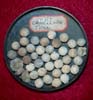
Buckshot, Fort Donelson.
Click to Enlarge |
This is a tray of approximately 40 lead "buck" shot excavated from Fort Donelson battlefield area. Early in the war, two of these buck were fired along with a musket ball from the older, non-rifled guns. They were supplied to troops in paper cartridge packages containing two buck, a ball and powder charge. Thus, they are known as "buck and ball". When excavated, they can be found separately as in this case, or adhered together in a lump of two buck and a ball. Later in the war, the more accurate rifled muskets started using the longer, cylindrical minie balls rather than such circular shot. These came from the old Colonel Vietzen Civil War and Indian Museum in Elyria, Ohio.
Leather Civil War Carbine Box
Click to Enlarge |
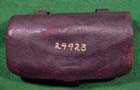
A very good condition Leather carbine cartridge box
from old GAR Hall collection which was saved from the trash by renowned Civil war dealer Ron Stonelake. Sadly, without people like Ron who strongly loved history, many great Civil War relics were not recovered in the past! This has a "reference" number (24423) painted on its cover by the Hall.
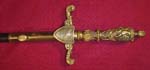
M1840 Pay Department Sword
Click to Enlarge |
Essentially, this is the same sword as the 1840 Medical Staff Officer's sword that was used during the Civil War, but was also used by civil staff and ordnance storeskeepers. Entire hilt is heavy brass exactly the same as Medical Staff Sword but no applied letters in shield. The blade is pyramidal in cross section, 31 3/4" in length with deep fullers on all three sides. Narrows to a wickedly thin point at tip.
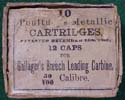
1863 Gallager Cartridge Package
Click to Enlarge |
This is an original package with label which held ten
"Gallager's" cartridges, and also 12 percussion caps.
Pat. Dec. 15, 1863.
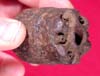
Cylinder of Percussion Revolver
Click to Enlarge |
Excavated relic from percussion revolver; possibly a Colt
Navy. Can still see some of the cap nipples.
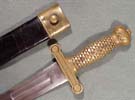
Model 1832 Foot Artillery Short Sword and Scabbard
Click to Enlarge |
This is an extra fine example of the Model 1832 U.S. Artillery Short Sword along with its scabbard. It has a nice bright blade carrying many maker and inspector's markings on its ricasso. Made by the famous Ames Mfg. Co of Chicopee, Mass, suubsequent army ordnance inspectors would add dates and their intials to the base of the blade to mark their approval of quality. HKW /NJ/US/ADK/1855. We can also see the "NJ" for New Jersey, an uncommon state armory. Finding a leather scabbard so beautifully intact after 160 years is difficult since they would often molder, rot or be eaten by mice in closets and cellars. This one is superb!
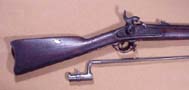
1862 Standard Contract Musket from Civil War
Click to Enlarge |
This is the standard rifled musket used by Union troops during the Civil War. The Federal government made contraxcts with various large companies to supply these in large numbers to a quickly growing Northern army. THe Southern forces were not blessed by such a powerful manufacturing ability and needed to depend on imported European muskets of varying types initially. Bayopnets were still an important part of warfare during charges and desperate "last pitch" efforts in the trenches during the Civil War.
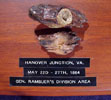
Wood Fragment Containing Minie Ball; Hanover Junction,1864
Click to Enlarge |
A nice minie ball imbedded in a fragment of the tree it hit.
Trees, fallen trunks, firewood and fence posts were often riddled with bullets. Years later they are found by running a metal detector over the wood. Upon splitting open the wood, there lies a bullet inside, sometimes mangled by impact and other times amazingly intact looking.
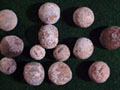
Fired Lead Musketball
Click to Enlarge |
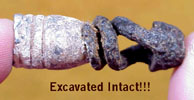
Pulled Minie Ball lodged in a Wipe!
Click to Enlarge |
Civil War soldiers often used the corkscrew tips of their musket wipes to remove bullets that got stuck in the bore cavity. These would be advanced upon the end of the ramrod to the point of obstruction and then twisted into the soft leaden nose of the stubborn bullet. We often find the impression of their sharp tips in discarded bullets. But in this case, the soldier could not later separate the two and discarded the wipe tip along with the bullet. The two have remained in such a conjugal union for over 135 years! This comes from an olden-time Virginia digger's collection!
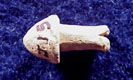
Carved Minie: Interesting Shape!
Click to Enlarge |
Bored soldiers, sitting around in camp, often carved the soft lead of their bullets into creative shapes, such as animals, chess pieces, fishing sinkers, pencils tips, people and practically anything imaginable. This mushroom shaped item could be interpreted in many, many ways... It was excavated along the old railroad lines near Corinth, Misssissippi. One can see the digger's ink notations still on the crown.
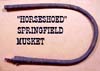
A bent musket barrell
Click to Enlarge |
When weapons were captured and meant to be kept from falling into enemy hands later, quick-moving units with no supply lines back to their rear would either dismantle pistols and muskets for parts or destroy them. In the case of this standard Union .58 musket, the barrel was heated red-hot above a pit-fire and then forcibly bent around a tree trunk to make it into an non-functional "U"-shape. Such heateded bending was also done with torn-up railroad tracks to prevent the enemy from rebuilding their lines. It has a steady pin notch in the dovetail for the rear sight, so it was either a model 1855 or a Richmond rifle-musket. It was excavated near Fredericksburg, Virginia. We know where, but not who and why...
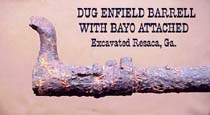
Excavated Enfield Musket with Affixed Bayonet
Click to Enlarge |
This British Enfield musket was excavated from the Resaca, GA area. It was used by both Union and CSA forces, but moreso by the South which could not manufacture enough firearms for its armies and thus had to import from England. Its bayonet was affixed when this weapon was lost, suggesting that it was being used in battle. Since the barrel is slightly bent at its center, something nasty probably happened to the troop who carried it. No lockplate, trigger guard or butt plate were found. Either they were blasted away or scavenged for parts.
Sharpshooter's .45 cal. Cylindrical Whitworth
Click to Enlarge |
A very nice example of the short-variety of the cylindrical .45 cal. Whitworth bullet with a dished-base. (1 1/8" long) Whitworths were tremendously accurate rifled-muskets mounted with scopes that were imported from England by the Confederate States. Their bore is hexagonal and their bullets follow that longitudinal profile. These guns were given to the South's best sharpshooters, who were quite deadly at picking-off Federal officers. This tended to confuse and disrupt regiments who'd lost their leaders. General Reynolds was killed on day one of Gettysburg by such a sniper, as was General Sedgwick soon after snickering that the rebels "could not hit an elephant" at their extremely far distance. This item came from the collection of an older gent who found it near the Perryville, Kentucky battlefield.
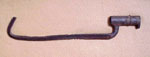
A Corpse-hook Bayonet
Click to Enlarge |
This Civil War Enfield bayonet was dug from along the Railroad tracks, 300-400 yards down from the site of a Confederate camp just outside the Orange County Hospital. This camp was where typhoid victims were isolated. The bayonet has been bent to a hook on the end. These were often used to drag corpses off to burial. Could also have been used as a pot hook, but the proximity to a hospital dying-field suggests the prior use! Similar hooks were no doubt used after battles to clear the dead. More often than not, burial details, often made up of conscripted slaves, would toss bodies onto buckboard wagons or bury them on the field. Long trenches were dug with bodies laid side to side, the dirt from the next space tossed over to cover the previous body in line.
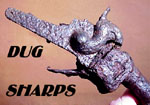
Excavated Sharps Carbine!!!! (Bermuda Hundred)
Click to Enlarge |
The Civil War saw the rapid evolution of firearms. The carbine was a short rifle often used from horseback that employed a self-contained cartridge type bullets rather than the old method of stopping to ram gunpowder and bullets down the open muzzle end. Thus, carbines were "breech loading," meaning that the gun somehow pivoted open near the hammer to allow loading of a cartridge at the back end of the barrel chamber. The gun was then closed and fired. Cartridges started incorporating a firing charge within them at their rear aspect. Thus, the strike of the hammer would cause a spark-flash within the cartridge itself, setting off the rest of the charge in the brass casing and letting the bullet at the tip fly. Our modern bullets employ internal strike anvils and fire in this same basic manner. During the Civil War, this concept was fairly new and exciting, allowing much more rapid, relatively hands-free firing. But these firearms were expensive and not bought in large numbers by the two Governments for their troops. Oddly, soldiers were allowed to buy their own carbines and better-quality rifles privately if they got approval from command. The Spencer was an extremely popular firearm because it carried a number of cartridges in its stock which forward-loaded into place one by one. Thus, it was essentially a "repeating" rifle. There are reports of small forces of men during the Civil War who were luckily armed with Spencers and effectively decimated much larger opposing forces armed only with the old single-shot muzzle loaders. "They fired all day without reloading!" was the lament of the vanquished. This was excavated near the Bermuda Hundred Plantation along the James River in Virginia. Look at all the details still showing! You can see the outer release latch, the gutter for the shell, even the firing spring inside! This has been treated by electrolysis to remove rust concretions and then was treated with polyurethane to stall any further flaking/deterioration. Only about fifteen inches of the barrel remains.
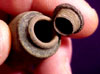
Oiling Can
Click to Enlarge |
This is a brass oil can with a screw-top lid that still works. It originally held oil used to lubricate the mechanisms of rifles or pistols. It is only 1 1/4" in size!!!!These are hard to find these days!
Pinfire Relic

Click to Enlarge |
This is a very nice pinfire revolver that comes to us from an old Civil War collection. Unfortunately, no site of recovery tag! The cylinder, barrel and cylinder frame are fused in a light surface rust. The chamber ramrod is intact too. No flaking. This is a solid old relic that is quite nice. 7 1/2" long. Wonder who carried and used it... and why it was lost.
Relic Savage Percussion Pistol

Click to Enlarge |
This is a Savage brand of percussion revolver from an unknown Civil War sdite. It is a shame when relic were recovered but not tagged with their site of discovery. It disconnects them a little from their true past. In this case, the weapons is intact except for its loading lever and the wood grips which rapidly decay when underground. Who knows what this gun faced in the hands of a Union officer? Was it lost, abandoned or fallen from a mortally wounded hand...
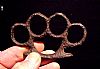
Iron "Brass Knuckles"
Click to Enlarge |
If you are in a "last ditch" despoerate fight for your life in the trenches with no gun, no sword, no nuthin'... well it never hurts (you) to have a piece of molded iron over your fist called a "brass knuckle." It is far better to knock out your enemy with a punch than to get shot or jabbed yourself! You can figure out what to do with your unconscious prisoner later! These are a nicely preserved set of brass knuckles dug from an unknown Civil War campsite. Ouch!!!
Civil War Period Double Action Pinfire Revolver
Click to Enlarge |
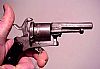
This is a small double-action pinfire revolver from the Civil War period. It has markings on it which I believe indicate Belgium as its source. Many revolvers were imported from France, Belgium & England to help supply the early needs of the Southern States before their own small, new factories could jump into production. Some of these pinfire revolvers were already privately owned and simply brought along to war as back-up weapons. This revolver is complete and movements work perfectly. Very nice example with foldup trigger. Grip dark walnut in fine shape. The "pinfire" was a bullet on a brass casing that actually had a raised pin on it. The hammer struck the pin and drove it into the gunpowder chamber. In the mid-1800's there were many methods tried for setting off the powder charge in bullet casings: caps, rimfires, even combustible skins. Eventually, the small "anvil" on the base was favored. It is that round dimple that you still see on the bottom of our bullets today. About 6 1/2" long.
Unique Naval Sword Mount Spotsylvania
Click to Enlarge |
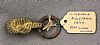
This is a rather unique find from Alsop Farm to the rear of Goshen Church at Spotylvania: a Naval Sword brass scabbard mount! How a navy officer got into that battle is anyone's guess. Has old tag. Dug with landowner's permission.
Melted Chunk with minie ball and case shot

Click to Enlarge |
This is a great specimen! A digger excavated a huge chunk of melted iron that contained numerous grape shot balls (1 inch) and minie balls in a volcanic slurry. This probably resulted from a fiery explosion or conflagration of munitions that melted everything together. The digger broke off chunks and has sold them to happy buyers like myself. This piece is about 2" x 2" with a melted iron matrix. It contains a grape ball and a minie ball. A great paper weight!
Lorenz 4-sided Bayonet

Click to Enlarge |
This is a Lorenz CW period bayonet for the imported Austrian rifles which were usually used by Confederates. It has a nice gun metal patina. No locking ring. The 4-sided blade measures 14 1/2" which may have been shortened in the course of its use.
One bullet shot through another in flight!
Click to Enlarge |
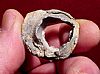
When lead bullets were flying upon the battlefield as thick as gnats on a hot bayou, occasionally two would collide in mid-air. Such is the case with this marvellous dug relic. One bullet plowed straight through the center of another! I would not want to be in a conflict with missles that thick in the air!!!
Belgian pre-CW period Boot Pistol
Click to Enlarge |
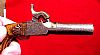
These single shot percussion boot pistols were common in America at time of CW from the previous generation. They were often taken as extra precautionary weapons. The Belgians produced many firearms used in pre-CW and CW period here. This lovely boot pistol bears a Belgian Hallmark. The barrel unscrews as shown in photos. There is hand-engraving on body, base & backstrap. As hammer is pulled back, the trigger drops down from being flush to base. The walnut grip is carved into ribs and scalloped. Bore is good. This is a pretty little weapon that might save your life in combat when the regulation musket was already empty and they kept on coming!
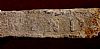
Lead pig or bar for casting bullets, marked
Click to Enlarge |
During the Civil War, this type of small lead bar was often used to field-cast needed bullets. The bar was melted over a fire in an iron pot or ladle, the molten metal then being carefully poured into an appropriate bullet mold. This lead bar is marked "WIND" and could well have been used by the Confederate forces. Of course, larger bars were also used in armories and larger supply depots but would be unwieldy for use near the front lines.
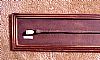
.58 Caliber Ramrod: Chancellorsville
Click to Enlarge |
This is a standard Union .58 caliber ramrod with the flare in the neck. It was dug along Mineral Springs Road in Chancellorsville in the 1970's. It is in nice shape except for surface rusting. Comes mounted on a wood plaque.
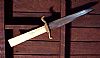
Ivory Handled Gamblers Prostitute Fighting Dagger
Click to Enlarge |
Check this out! An original Civil War period Ivory-handled Fighting Knife or Dagger. It was probably made in England but no maker's mark is left showing. It is very fine quality. The squared ivory grip has some small age-shrinkage cracks that do not affect its strength. A brass hand-guard bears a variation of snake-shaped guards on other dirks. The blade is steely-toned with some faint peppering after having been cleaned in the past. This peppering was most often result of moisture or even possibly acid from dried blood stains. This is the type of "sticker" that was often used in close hand-to-hand raw fights, such as in saloons or in back alleys. A favorite accessory with sailors, desperate troops in trenches and ticked-off prostitutes! Length: About 8 1/2".
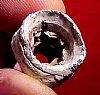
Bullet used as a makeshift nipple cap for a musket
Click to Enlarge |
This shows the inventiveness and adaptability of soldiers! A standard 3-ring lead minie was modified into a nipple cap for a musket. The nipple was a small raised protrusion or attachment to the rear (stock side) of the steel barrel. A tiny metal cap was placed down over it. That cap contained a charge of dried fulminate of mercury which would ignite to a flash or spark when struck by the musket hammer. The spark then traveled down the hollow shaft of the nipple into the powder charge within the barrel. In order to prevent debris and denting of the vital nipple, caps were often devised. The Enfield rifles from Englank often came with caps held to the gun by chains. By American muskets had no such nipple caps. Thus, soldiers improvised. The shape of the nipple can be seen on the underside of this modified bullet, while the musket hammer's impression is seen on its top.
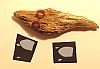
Minie imbedded in center of Limb with X-rays!
Click to Enlarge |
Many bullets ended-up fired into trees during battle. Those that survived continued to grow with the lead bullets imbedded in their limbs and trunks. Years later when they tree died naturally or was cut-down for firewood, these bullets were still held deep within their cores. In battle areas, a relic hunter can often run his metal-detector over old, fallen trees and get the characteristic electronic "ring" of a bullet!!! By breaking open these chunks of wood, a bullet is then found nestled in the center, sometimes gnarled-up from impact, and other times, looking amazingly unscathed after hitting and living in a tree for 140 years! I recall a story from some relic hunters which bears repeating: They were looking for bullets on an old battle site with little luck. But then, it began to downpour and thunder. They ran into a deserted barn to escape the rain, and while there, they started running their metal detectors over a rotting pile of firewood, simply as a joke. To their utter joy, they found four or five logs that contained actual Civil War bullets. They found more hiding inside from the rain than relic hunting the fields! This chunk of tree wood is not from that episode, but it could have been. It was found because it gave the signal of heavy metal such as lead or brass, as well as had a weight much greater than mere wood when tested in the palm. The collector had it X-rayed to see what was inside. And lo and behold, a Civil War minie ball revealed itself, as seen in alignment to the marking arrows. It still remains unopened to this day. Comes from the Battle of Rock Face near Dalton, Georgia.
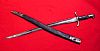
Enfield Saber Bayonet
Click to Enlarge |
Besides the typical triangular blade design for socket bayonets, there were "Saber" bayonets. These were found on some models of both American and European muskets. This one comes along with its original leather scabbard. Possibly made by the famed German blade manufacturer Kirschbaum due to the knight's head marking on ricasso of its blade. It is interesting how various European armaments found their way into both the North and South in order to supply the needs of the Civil War.
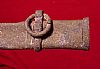
Part of a Civil War Sword Scabbard
Click to Enlarge |
This is a 20 1/2" fragment of an iron scabbard for a CW officer's sword. It has one hanger loop still on it. It came from private land in the Richmond area. Perhaps a CSA use??? There are no markings. It was broken off at a little more than half its original length. And one must wonder, what would happen to the man beside it if such steel were shattered in helklish warfare?
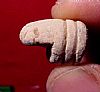
A smiling animal minie!!!
Click to Enlarge |
This happy looking carved minie ball might have reminded a troop of his dog back home or a relative who would never stop chattering.
A Percussion Double Barrel Shotgun : Brandy Station
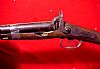
Click to Enlarge |
This was found in an old barn in Brandy Station, Virginia. It is a neat, old double-barrelled percussion shot gun. No maker's marks seen. It is smashed in half at base of barrel, breaking the wood where the forestock takes off at the front of the trigger guard. Brandy Station was the site of some major action in the Civil War. Who knows why this was smashed: in a shirmish... in a battle... or to prevent local citizens from using it against visiting Union forces??? There is no other exact history on it. Just left to your imagination!
Ames Model 1840 Artillery Saber
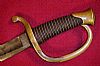
Click to Enlarge |
This is a very nice example of the 1840 Artillery Saber which has obviously been to battle and brought home by a trooper. It has some minor dings to brass and one edge nick that likely came from impact with another sword eith during masneuvers or battle. The Ames marking "Ames Mfg Co. Chicopee.Mass" is slightly light from weear during use and cleaning blade. As is typical with most Union Civil War swords, it carries both a date and an inspector's marking on the base of blade itself (area called the ricasso. The leather on grip and wire binding are present as is a leather collar called a "bumper guard" which keeps guard from clanging & banging into throat (opening) of the scabbard. This blade has never been sharpened or chromed. Sadly, which soldier carried it to war is unknown.
1816 Model Bayonet, from South Carolina allotment
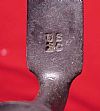
Click to Enlarge |
This is a standard 1816 socket bayonet that is 19" long overall. It is fluted a little more than half the blade length and of course no lock ring yet. It is marked US/SC, meaning it went to South Carolina as part of its allotment as set forth by the Militia Act of 1808. A bayonet likely still used by Confederates early in the Civil War. Has an overall slight rough spotting but solid with a pretty dark patina.
69 caliber ramrod from Harpers Ferry
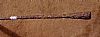
Click to Enlarge |
A flared tip ramrod of the type used on .69 caliber muskets. Used to shove the round musket call all the way down the inside of the barrel till it sat against the black powder charge at the bottom. Recovered in Harpers Ferry area from private land. 32 1/2" long. Rusted, rough but solid.
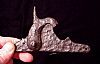
High Hump Richmond Lockplate
Click to Enlarge |
A very rare High Hump Richmond Musket Lockplate. It was dug in Petersburg VA.
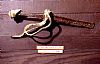
1860 Cavalry Saber excavated in Cold Harbor
Click to Enlarge |
Too neat for words! This gnarled fragment of an 1860 Union Cavalry saber was found atop a trench many years ago at Cold Harbor! The broken blade is poly-coated to prevent further deterioration. The three branched guard is twisted as if by a powerful explosive force. Whoever was carrying this during the famed battle certainly did not leave the field in the unpright position! Raw awesome relics do not get better than this one!
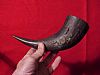
Bull Horn powder horn
Click to Enlarge |
This is an actual bull's horn made into a powder horn as used by hunters and soldiers prior to and during the Civil War. More likely carried by Southern troops if machine fabricated brass powder flasks were not available. As war progressed, paper cartridges had powder inside and pouring-your-own powder was no longer necessary. Unclear if this was used in war or not. About 9 1/2" long. Has some chew marks from bugs (not sure what eats horns...)
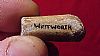
Fired Whitworth Sniper Bullet
Click to Enlarge |
The Whitworth rifle was a high precision long-range rifle imported from England mainly by the Confederacy for the use of snipers. By eliminating the enemy's senior staff officers, effective tactics and quick decisions about troop movements could be delayed during pivotal times in battle. General Reynolds was killed early in the course of The Battle of Gettysburg by a sniper's bullet, requiring the quick intervention of Hancock and others in his stead. As the Civil War progressed, Union officers obtained permission to dispense with their prominent shoulder straps which clearly made them marked-men on the field. This bullet shows the classical Whitworth octagonal shape at its base. But the nose is flattened from a direct impact. While a blow to a human bone could do that, it is more likely that a tree or ground flattened the front of this lovely relic. Site unknown. Not for sale.
Gardner's Explosive Bullet
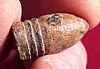
Click to Enlarge |
A most feared item! A lead bullet with an explosive internal charge. It was ignited by an interal fuze about 1 - 2 seconds after being fired from the musket. Thus, the bullet might well be lodged in an unfortunate enemy soldier's body when it exploded! And even if these had exploded before hitting their target, they were transformed into a raw, jagged missile of great lacerating and destructivbe power. Thirty three thousand of these were bought by the Union Army, being used between 1862 and 1864. Deemed cruel, they were soon banned in Europe and not used by U.S. Troopers past the era of the 1870's...
CSA Slug
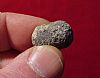
Click to Enlarge |
This big lead slug was used by the Confederate forces for their shotguns. These are not common. It is a very heavy projectile which was capable of a lot of physical damage. But only accurate at very close range. OUCH!
Model 1840 Medical Officer's Sword
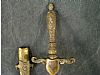
Click to Enlarge |
This is the Model 1840 Medical Officer's Sword which was still the design supplied to Union Surgeons during the Civil War for dress purposes. It has "M.S." within a shield of stars. The grip shows an eagle and has fancy curved quillons sticking out to side. The blades are usually etched with words "Medical Staff". As you can see, even the scabbard is highly decorated. The sword was for dress-parade and social events between doing their rushed and bloody amputations in white smocks with rolled-up sleeves.
A rare Mississippi Saber Bayonet
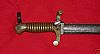
Click to Enlarge |
This is a rare and unusal "Mississippi Rifle" (Snell Alteration) saber bayonet from the Civil War era. It sports a 22 3/8" blade which is mostly grey with overall scattered age staining (often called "peppering" by collectors)... It has an untouched brass handle with nice medium honey-toned patina. Just a few bumps and dings from its illustrious military usage. The front muzzle-ring is marked "C 50". Such Confederate bayonets are extremely rare and treasured by specialty collectors. Imagine being a Northern soldier and seeing a young adrenalin-charged Confederate lunging toward you with one of these awesome blades in the trenches just outside of Petersburg in 1864?
Super Cavalry Saber Grip and Rustng blade
Click to Enlarge |
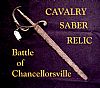
This is a very attractive "historic relic" grade Civil War cavalry saber recovered from private lands with permissiuon around Chancellorsville, Virginia. The branched grip is in the Horstmann Brothers (Philadelphia) pattern of the 1840's to 1850's that was still being carried by many career officers. It is slightly bent from whatever disasterous end befell its owner during this huge pitched battle of 1863. An 18 inch rusted section of its blade remains. With the tang slid through the opening in the bronze grip, it looks very cool. The wood or ivory components of the grip, as well as the tip-end of the blade, are long gone~ either corroded away or blasted away in this fitful battle. No scabbard.
Buck & Ball Set from Siege of Port Hudson
Click to Enlarge |
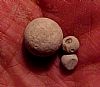
The Confederate soldiers lining the trenches in the marsh were armed with obsolete .69 caliber muskets... but they waited until the ranks of oncoming Federal troops were very close before letting loose their volley. They fired that old-style "buck-n'-ball" from their aged guns: one lead ball and two small lead buckshot. The hail of death was fiercesome at close range. And thus, they staved-off the onslaught of a much superior force, now reduced to a wounded, disheartened shambles! These buck-n'-ball sets come from the long-drawn-out Union siege of Port Hudson, LA.
Globs of melted lead & metal
Click to Enlarge |
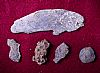
From a Fredericksburg homestead used as a Civil War camp. Larger is lead and others lead or zinc. The troops often "recycled" lead by putting it in firepits or cauldrons over the flame. It could hold heat to warm them but also be repoured into molds for bullets needed in the field, especially pistols whose ammunition might not be standard military issued. They often carried specific caliber molds for just such a use. I have also seen melted lead used to fashion desperately needed temporary parts for guns and equipment: plugs, catches, fishing sinkers, musket nipple covers and fanciful carvings
Burnside Carbine Block & Lever from Malvern Hill
Click to Enlarge |
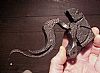
This is a very nice remnant of a Union Burnside carbine as carried by mounted troopers. It is the block, nipple and loading lever. It was excavated near Malvern Hill, Virginia from private land with owner's permission. To think that a young Union Hellion on a horse charged into smoke and a deadly hail of lead while pumping this lever to fire return shots at his enemy.
Rare Custom Made Confederate Fighting Knife
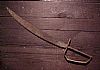
Click to Enlarge |
This is indeed a rare item recovered in Chickamaga area which was probably custom made for a Confederate trooper. This large knife has a blade that was likely a cut-down cavalry saber turned into a very long & hefty D-Guard knife for hand-to-hand fighting. The blade is a whopping 15 inches long! The iron hangguard is custom forged by a period blacksmith. The blade has typical pitting to its metal but is solid & sturdy with no flaking. Such large Southron fighting knives are indeed now rare as hen's teeth. It came to us from an old collection.
Dug Fighting Knife from Cumberland Gap Tennessee
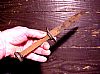
Click to Enlarge |
This is a dug fighting knife dug years ago in the Cumberland Gap, Tennessee area with land owner's permission. Wood grips gone but still snugly peened. Moderate surface rust to blade. An impressive 11 & 1/2 inches long. No markings.
Mansfield & Lamb Relic CW Cavalry Saber
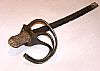
Click to Enlarge |
The fractured remains of a Union Cavalryman's sword from a battlefield. This Model 1860 shows part of the Mansfield & Lamb, Forestal, RI marking on ricasso. The blade is broken and rough from years in the elements. Unclear if dug or a very late field pickup. The brass knuckle guard is intact but bent. The wood grip broken in half with no pommel. This swords was pulverized by something horrific in battle. A very cool "been there in the absolute thick-of-it" item!!!
Intensely melted musket ball glob White Oak
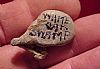
Click to Enlarge |
What degree of heat would be needed to melt a musket ball into an irregular glob of lead like this one??? This comes from the collection of a very old digger. He labeled it on the item directly. Deadly conflagration? A Cool Survivor or a Fatal mishap???
Wood Plug Enfield
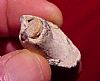
Click to Enlarge |
This is an Enfield lead minie found at site of famous Antietam Battle. It still has it's wooden base plug locked into curved lead from impact.
CW musket caps from 1862 Blockade-Runner Minko
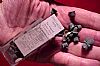
Click to Enlarge |
Nicely preserved brass musket caps from blockade runner "Minho" which grounded off Fort Moultrie on 20th October 1862. These were brought up by maritime salvagers!
Fractured Artilleryman's Saber from 1864 Spring Hill
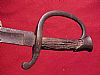
Click to Enlarge |
This is a broken rusted Model 1840 Artillery Saber found on a farm in Spring Hill, Tennessee. There was a battle there in 1864. No markings can be seen on pitted ricasso of blade. Wrap is gone but grip is still sturdy. Such blades were often made by Ames. This could have been in possession of either a Union or Confederate Artilleryman. The label that came with it says "Confederate" saber but I am not sure how they could really tell that. Blade broken. What remains is solid. No scabbard. Background: Spring Hill was the prelude to the Battle of Franklin. On the morning of November 29, 1864, following the inconclusive Battle of Columbia, Confederate General John Bell Hood’s Army of Tennessee marched from Columbia toward Spring Hill to isolate major portions of Union forces from each other, hoping to defeat each in turn before they could unite and overwhelm him. Union Maj. Gen. George H. Thomas's Army of the Cumberland was north of Spring Hill in Nashville, Maj. Gen. John M. Schofield’s Army of the Ohio was south in Pulaski and divided into fragments.
Hood sent the corps of Lt. Gen. Benjamin F. Cheatham and Lt. Gen. Alexander P. Stewart on a flanking march north, crossing the Duck River east of Columbia while the corps of Lt. Gen. Stephen D. Lee on the southern bank diverted a Union division under Brigadier General Jacob D. Cox across the river. Hood rode near the head of the column and hoped to catch Schofield by surprise.
Cavalry skirmishing between Brig. Gen. James H. Wilson’s Union cavalry and Maj. Gen. Nathan Bedford Forrest’s Confederate troopers continued throughout the day as the Confederates advanced. Forrest had executed a wide turning movement with 4,000 troopers that forced Wilson north to Hurt's Corner, preventing the Union horsemen from interfering with Hood's infantry advance. However, Wilson did manage to warn Schofield of Hood's advance and the Union trains—800 wagons—were sent north in the direction of Franklin.
[edit] Battle
While Hood’s infantry crossed the Duck River and converged on Spring Hill, Schofield sent troops to hold the crossroads there: Maj. Gen. David S. Stanley, commander of the IV Corps, with two divisions under Maj. Gen. George D. Wagner and Maj. Gen. Nathan Kimball. Starting at 4:00 p.m., close to sunset, the Federals repulsed infantry attacks launched by Cheatham's corps. The attacks failed for four reasons: poorly coordinated, piecemeal attacks by Cheatham; excellent Union defensive artillery support and a decision by Hood to leave most of his artillery pieces in the rear; mispositioning by Hood of Stewart's corps, left too far to the south at Rutherford Creek to support Cheatham until Hood released it after dark; and the failure of Forrest to arrive before dark.
By nightfall, the Confederates had finally positioned their corps where they could attack and severely damage Schofield's force, but they erred by allowing the Union army to maintain possession of the road and keep a route open for withdrawal. Believing the battle largely finished, Hood left command of the field to his most capable commander, Maj. Gen. Patrick Cleburne (the "Stonewall of the West"), after sending the order to attack Schofield. However, due to a communications failure of unknown cause, Cleburne never received the message, and never attacked. When Stewart arrived, his corps merely went into bivouac next to Cheatham and the soldiers of both corps cooked their supper and went to bed.
Dug Musket Lockplate Maynard Type Fredericksburg
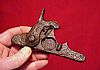
Click to Enlarge |
This is a very nice dug Union Civil War musket lockplate from just outside Fredericksburg, VA. It is the type that took the Maynard tape of caps. It has overall rusting but is sprayed with clear poly to stabilize it. Has lots of detail to the pieces on the inside and outside aspects.
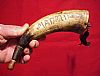
1855 New York Powder Horn with tiny shot
Click to Enlarge |
Prior to Civil War era, powder was often carried in flasks or horns and poured onto the "pans" of flinklock type muskets. This is an original powder horn with maker's name scratched in rim "G.R. Wright." It also has "Madrid, NY, 1855" scratched into body. There are some tiny lead birdshot inside still! Has end plug and some decorative cord on wood end cap. Some surface insect holes, but overall is solid & pretty. About 9" long.
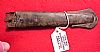
Union Officer's Sword Scabbard Drag Cold Harbor
Click to Enlarge |
This is a very cool heavy brass drag from a Model 1850 Union Officer's Sword dug at bloody battle of Cold Harbor. It is likely an Emerson & Silver as the scabbard was iron, not leather. Can still see design on it. Wonder who polished it earlier in CW that did not survive Cold Harbor?
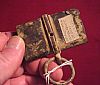
Confederate Officer Scabbard Ring Spotsyvania
Click to Enlarge |
This is a Officer Sword brass Scabbard mount and ring. Found in Confederate trenches at Spotsylvania by famed collector Bill Gavin. Has his old tape tag on it. Very neat item from raw battle.
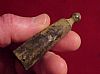
Confederate Brass Scabbard Tip Corinth, MS.
Click to Enlarge |
This was found years ago by relic hunter John Graham. It is a heavy brass Confederate-local bayonet scabbard tip. From Corinth, Miss.
Confederate Militia Sword Drag Corbin, VA
Click to Enlarge |
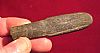
This is a very unique sword scabbard drag that is engraved with fine designs. It was located years ago by renowned reli-hunter Bill Gavin in Corbin, VA, probably Camp Santee, the 1862-1863 winter camp of Hill's Division. Why would an officer dispose of such a cool hand-engraved sword?
Ringtail Sharps split to a whistle
Click to Enlarge |
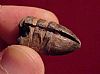
This is a Ringtail Sharps bullet dug in a CW camp. It may have been split in attempt to make a crude whistle. Has scrap paper note from old digger.
69 Caliber french Minie of Rebs
Click to Enlarge |
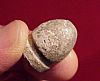
This is a large triangular based French minie imported by Confederates early in war when any kinds of rifles could be had. Minor rim dent.
Barrel and Cylinder Moore Revolver
Click to Enlarge |
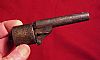
This is the barrel and cylinder of a Moore revolver. Likely an early battlefield pickup by souvenir hunters.
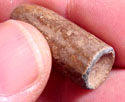
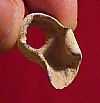
Blow through bullet
Click to Enlarge |
This is a fragmented Civil War "blow thru" bullet. When cast poorly, the charge would burst through center of bullet, leaving a hollow tube! Cool!
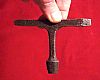
Combination Musket Wrench Tool
Click to Enlarge |
This is a very nice "combination" musket tool with a nipple wrench and screw drivers on its wings. It was recovered along Route 11 in Maryland. Smooth and black with minimal wear. Possibly Confederate. The digger's ID number is painted on its neck.
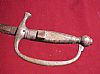
Union Musician Sword Gerttyburg Museum Relic
Click to Enlarge |
This is a Union Musician's Sword that was purchased in the mid 1960's from the Fort Defiance Museum that was located south of Meade's Headquarters on the Pike in Gettysburg. The museum no longer exists but sold many great relics collected off the battlefield by local families. At the museum, it had a notation that the sword was "found behind Confederate lines after the third day's battle (Pickett's Charge)". That is not far from the former Eisenhauer Farm. This sword was obviously a later field pickup, as it has a rusted blade that was worn or broken a little short from use and then reshaped at tip. It's grip was silvered (nickeled) for later wall display. And an interesting metal hanger was custom attached to the grip, likely to slide over a wall clip at the museum. Unclear if a Reb adopted this sword earlier in battle or if a Union troop lost it later in the chase after Picket's charge. There were plenty of swords with full length blades to "exchange" off the field after thye fray! A very cool item!
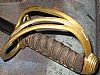
1833 Ames Dragoon Enlisted Mens' Saber
Click to Enlarge |
This is a Model 1833 US Dragoon Saber made by N.P. Ames. The blade is single edged, slightly curved. Leather covered handle is slightly worn from use. Ricasso is marked in engraved script "N.P. Ames/ Cutler/ Springfield/ 1837" About 6100 were contracted for. This one has no scabbard. The blade is plum gray, having been cleaned in distant past. The brass grip is sturdy. A very nice, hard-to-find early US "cavalry" sword.
Bullet in larger chunk wood from Bentonville
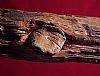
Click to Enlarge |
This is a Union three-ring minie that flattened as it impacted a tree during the Battle of Bentonville, NC. It was recovered in 1973 by Kit Akin in Hoke's Lines. It is almost a foot long!
Melted lead and musket caps Manassas
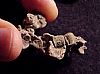
Click to Enlarge |
This is a cool irregular glob of lead, likely from melted bullets, which has two musket caps imbedded into it. From Manassas.
Musket cap with melted bullet lead
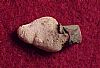
Click to Enlarge |
The battlefield infernos created some odd relics! This is a brass musket cap with lead from a melted bullet oozed into its recess. Imagine the intense heat to do that. It is said that when some soldier's cartridge boxes were hit by a bullet, they exploded in flames!
Tagged lead Slug from Kilpatrick raid on Aiken SC
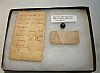
Click to Enlarge |
This is a cool old relic with original paper labels. A lead case shot from Aiken, SC. Fired during Kilpatricks's Raid. The original note and envelope state where it was found. Likely a very early war relic!
Relic Sword Grip Devils Den Very Old Collection
Click to Enlarge |
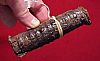
This Gettysburg scarred sword grip comes from an old museum collection of early field pickups while area was still private land. It is a wooden saber grip covered in worn leather. It has traces of an iron pommel and handguard. Thus, it was probably not standard Union issue which had brass guards. Likely, this was an older moldel from prewar militia that had an iron guard. One would surmise Confederate carried. There is no wire. No markings. You can see where blade fit into base of wooden grip. Comes with a tag from first collector after the museum deaccessioned this relic. Apparent find sit was Devil's Den area very long ago when private land and relic hunting still allowed in 1800's.
Cross Sectioned Pinfire Bullet
Click to Enlarge |
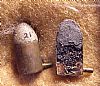
Pinfire bullets were used just prior to Civil War and sometimes still carried as older pistols. The pin was hit and pushed into casing where it struck like an anvil to cause a spark in a base of fulminated mercury. That ignition set off the main charge and sent lead bullet flying. This cross sectioned example beside an intact pinfire shows construction well.
54 Caliber Bullet in Paper Wrap Exposed to View
Click to Enlarge |
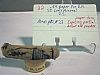
This comes from a neat old collection. It is a 54 caliber minie for a rifled musket. It was made at the St. Louis US Arsenal. The "bullets" in a CW trooper's cartridge box were wrapped in plain brown paper that also contained a specific amount of black powder charge/ Workers at arsenal then tied them closed with string by hand. During battle, the harried trooper would tear open the paper with his teeth, pour the powder down into the muzzle of his rifle and then drop the bullet in next. This paper cartridge is opened along one side to demonstrate the nestled bullet atop a powder charge. It is a very cool educational relic.
Old Mason Jar with Gettysburg Bullets and Case shot
Click to Enlarge |
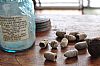
This is an old Mason Jar with a great assortment of bullets recovered from Gettysburg many years ago when still private land. We find a great assortment of musket types from both armies! Three Union minies. Three Confederate Gardners. Three Enfields, a musket ball and Williams Cleaner! Plus, there is a single pitted 1 1/2" iron cannister ball. The old Mason Jar bears a hand-written label stating these were indeed found at Gettysburg.
Big Stag Handled D Guard Bowie Hand Forged
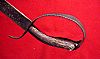
Click to Enlarge |
Here is a great Civil War Style Confederate Stagg Handle Short Sword D-guard Bowie Knife! It is just awesome! It is 26 and 1/4 inches long in length total. Has old milled, slightly surface-pitted thick blade and guard. Guard has a nice over-hang tip. The beautiful crown stag bone handle end is capped solid at the end of tang. Has a nice sheen from cleaning and oiling in past, with no rust or weak spots. This is a solid weapon to hold. No markings. Was cuHere is a great Civil War Style Confederate Stagg Handle Short Sword D-guard Bowie Knife! It is just awesome! It is 26 and 1/4 inches long in length total. Has old milled, slightly surface-pitted thick blade and guard. Guard has a nice over-hang tip. The beautiful crown stag bone handle end is capped solid at the end of tang. Has a nice sheen from cleaning and oiling in past, with no rust or weak spots. This is a solid weapon to hold. No markings. Was custom hand forged in the day. Essential if you were fighting for Lee! Was custom hand forged in the day. Essential if you were fighting for Lee!
Gettysburg Minie with imbedded stones
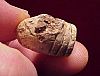
Click to Enlarge |
This is a minie from Gettysburg that has a couple tiny brown stones imbedded in it where the bullet impacted rock! This rarely happened to bullets. Usually they just dented or got gouged... A very cool find. This was recovered on private land with the owner's permission.
Rare Gardiner Explosive Bullet base marked
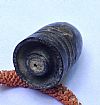
Click to Enlarge |
This is a rare, patented Gardnier bullet with an internal explosive charge within it. The thought was that it would explode when imbedded in a human target. These are rare in such mint conditions. The rim of the base has patent information raised around the edges as shown in this photo. This type of bullet was not successfully used in the US Civil War.
Fancy brass sword chain from Gettysburg collection
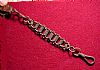
Click to Enlarge |
This is a very fancy brass sword chain that came in a box of old dug Gettysburg items. It has an ornate clip at top which shows a knight with a shield. This was not standard issue. It was likely a custom item bought from one of numerous military supply houses that officers on both sides patronized. I am not sure what kind of sword it was used with. But it is very, very cool. Overall length is 10 1/2".
Excellent Original Paper Wrapped 577 Enfield
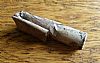
Click to Enlarge |
This is a very nice original paper wrapped 577 Caliber Enfield bullet from the Civil War as used most-often by the Confederates. Complete and in fine condition. This still retains wax sealant at top. The black seen in pictures are traces of powder. The soldier would rip open paper with his teeth and pour the black powder down barrel of his musket, next adding the bullet.
1859 Sharps Pepperbox Dug Near Gettysburg
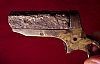
Click to Enlarge |
This is a four shot Model 1859 Sharps "pepperbox" pistol which was dug near Gettysburg. It has a steel barrel attached to a brass body. Hammer and grips gone. Iron trigger is nearly rusted away. A cool dug relic from private land with owner's permission to search.
Amazing Dug Percussion revolver
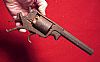
Click to Enlarge |
This is a relic percussion pistol from the CW era. Purchased in Gettysburg area but site unclear. Likely a very early field pick up or early dug item since not badly corroded at all. No grips. No markings seen. This is a big heavy handgun relic. Cylinder still can be rotated but springs frozen. Possibly, it had been cannibalized by passing soldier for parts and then tossed.
1863 Springfield Musket relic
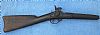
Click to Enlarge |
Very Nice 1863 Springfield Relic from year of Gettysburg. One must wonder who collected this battered fragment after battle and where. It has a lock plate with 1863 date and Springfield markings. Also, the Trigger Assembly and Butt Plate. There is no barrel. The hammer pulls back, but doesn't lock. The trigger moves freely, but doesn't engage the hammer. There is a fine surface roughness to metal as if it were left out in rain for a while till found. Neat item!
Dug Musket barrel and parts Charleston, SC
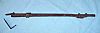
Click to Enlarge |
This is a dug CW musket from the Charleston, SC area. Dug private land with owner's permission. This has overall pitting but is solid & not flaking. The barrel still holds the nipple! Along with barrel were found: nose cap, a barrel band and iron butt plate. I am not completely sure of model, but could be a Lorenz which was heavily imported by South at start of war. This type of relic is now super-hard to find.
Heavy Iron Canister Enplate from Culps Hill Gettysburg
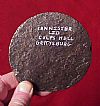
Click to Enlarge |
This is a heavy, thick iron canister endplate found on still private land many years ago on Culp's Hill at Gettysburg, PA. It was built into the ends of the elongated tin can which held sawdust and iron/lead balls. It was more solid, so it could absorb the impact of the powder blast in the cannon tube which drove the canister out like a huge shotgun into oncoming army. This one is coated in clear poly to preserve it and has identification in white paint on it as shown in photos. It is 4 1/4" across. A very nice relic from an old collection.
Lead pouring Iron Ladle
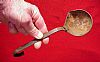
Click to Enlarge |
This is a forged iron ladle for pouring melted lead into molds. Probably for pouring bullets out in the field from lead scraps. No markings. About 9" long.
Relic Cavalry Saber from Globe Tavern
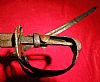
Click to Enlarge |
This is a great dug Civil War Cavalry Saber from the Globe Tavern Battlefield. Private land with owner's permission to dig. It is broken into two pieces! One section measures 17 3/4" including the grip, guard pommel and part of blade. The other part is the rest of the blade with a rusted tip at 20"- It is lightly coated with poly spray to preserve the iron. It comes from the collection of early relic hunter John Graham. It could have been used by either side, but a bit more likely was co-opted for use by the CSA. The Battle of Globe Tavern, Virginia (AUG -1864) was fought just South of Petersburg. It started with a raid "en force" by Grant's Army to cut off the Weldon Railroad line south of Petersburg. A quick response by General Lee led to a full battle involving three Union Infantry corps and two CSA divisions. Both sides finally entrenched around Petersburg. A super relic grade saber with real history!
Extremely Rare Brass Eagle grip of an 1841 Naval Cutlass
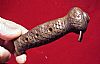
Click to Enlarge |
This is an extremely uncommon brass eagle grip for an Ames Model 1841 Naval Cutlass. The D-Guard is broken off, but its stem remains. A nice dark brown slick patina to brass. No markings. Has some heft. Not common to recover these.
Rare 9 Ring Sharps carbine bullet
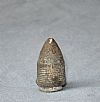
Click to Enlarge |
This is a rare variant of the Sharps carbine bullet with 9 thin rings on body. A nice dug example.
Civil War Bayonet Scabbard with hammered CS in frog
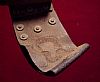
Click to Enlarge |
This is a cool relic from an older collection. It is a leather bayonet scabbard with brass tip which had "CS" custom-hammered into the frog many years ago. (Not recent work) The length for a bayonet blade is about 17" from opening to brass tip. Belt loop sturdy. This is a great old item with probable CSA connection. Leather dried and brass tip dented.
Custom Brass Cartridge Box lined with Plaster
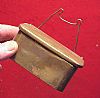
Click to Enlarge |
This is a very cool brass Cartridge Box. It is lined with plaster. I suppose it prevented injury to the soldier if the powder of cartridges ignited from a bullet strike. (This sometimes occurred when standard leather cartridge boxes sparked from a shrapnel strike!) This has a heavy gauge wire belt loop. There are no maker's markings. It reminds me of the 1863 Kittridge brass cartridge boxes, but is by another manufacturer. About 4 by 2 by 2. Lid works fine. Uncommon item. Custom bought by the trooper.
1863 Roby Union Musician Sword from Gettysburg barn
Click to Enlarge |
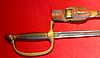
This is an 1863 dated Union Musician Sword with a C. Roby maker's marking which was found in a Gettysburg Barn on private land with owner's permission many years ago. It is marked "U.S. 1863" and "ESS" (inspector's initials). Amazingly, it has the original leather belt frog (holder). These were usually discarded or lost to the elements. But being held as a family souvenir in a dry barn preserved it! An amazing piece of Gettysburg Battle history!
Remington Zouave Bayonet cut to Fighting Knife
Click to Enlarge |
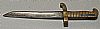
This is an 1863 Remington Zouave bayonet that was cut-down to a fighting "side knife" during to Civil War. Likely picked-up off a battlefield and fashioned into a last ditch accessory weapon for hand-to-hand combat. The honey-toned brass grip has inspector markings. Blade slight gun-metal but no pitting. Likely brought home from war and not left out in weather on a battlefield. About 13" long. A neat custom weapon.
Unique Heavy Brass Sword Hanger Wilderness
Click to Enlarge |
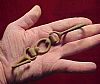
This is a three-pieced (jointed) heavy brass sword-belt hanger. Not standard Union. So good chance brought to war by a Confederate. It was found in 1980's in Saunder's Field at The Wilderness with the land owner's permission. Nice light green patina. No markings. About 5 3/4" long overall.
Base Cup of Hotchkiss with Sabot from Culps Hill
Click to Enlarge |
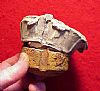
This is a nice combination of Hotchkiss shell base cup and its curled lead sabot. Recovered many decades ago on Culp's Hill in Gettysburg. This shell obviously burst and nose disintegrated into shrapnel. This comes from the Collection of Frederick Edmunds who owned the "Confederate States Armory & Museum" many years ago in Gettysburg.
1862 Presentation Sword to J. Harwood by Family
Click to Enlarge |
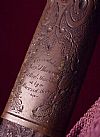
Often on marching off to uncertain warfare, Families, Civic Groups, and admiring soldiers often presented a sword to an NCO or Officer. These had the soldier recipient's name, unit, and often date engraved on the metal mount of the scabbard. This CW Era Union Officer's Sword was presented to J. Harwood, a sergeant of the 51 st Massachusetts Infantry by "By Harwood Brothers". It came through family descendants with a partial leather scabbard and a faded Officer of the Day sash/ tassels. A concrete link to a real soldier who survived the war and joined his local GAR post.
Gettysburg Area Dagger or Dirk from Lt. Werts 209 PA.
Click to Enlarge |
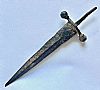
This is a non-regulation dagger or dirk recovered many decades ago in the area of Gettysburg with landowner's permission. It has a nice green-black patina to blade. No grip remains. It comes from the original collection of Lieutenant Howard Werts of the 209 th PA. Infantry. Most recently from collection of renowned collector "Hap" Hazard. Likely brought to battle as an accessory private weapon by a soldier who could use it as a last resort weapon.
Civil War Era Clip Point Fighting Knife steel horn brass
Click to Enlarge |
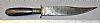
This is a quite lovely Civil War era "fighting knife". It shows file marks from original custom maker. No markings. Nice features include: A hand-made brass guard, Steel wire wrapping on grip near guard, and a deep brown horn grip. About 11 1/2" long overall. No wobble between parts. Just a lovely example of an accessory weapon for close trench combat.
Limonite Iron nodules from Alabama used by CSA
Click to Enlarge |
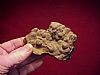
This is a small matrix stone of Limonite Nodules. The nodules are an iron oxide "bubble" (not a geode) that is formed in a low grade iron ore through water percolation through the ground concentration the iron values into the ore. This happened some 90,000,000 years ago. This iron ore was the basis for the first iron foundry made in Alabama at Cedar Creek in the late 1700s. It was also later the basis for the first US steel mills in Birmingham, Alabama in the 1800s. The steel mills made steel used by the Confederacy during the Civil war to manufacture cannons and rifles and other war goods. Today there is not much of this iron ore left.
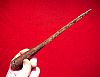
Hand Forged Hand-To-Hand Combat Iron Pike Tip
Click to Enlarge |
This is an original hand-forged iron pike tip sometimes used as a close, hand-to-hand combat "last ditch" weapon when defenses are closely breached. This metal tip or pointed-spike was mounted on a long wooden pole to be thrust or thrown like a spear. Such weapons common in warfare through the Middle Ages. But retained as ceremonial weapons even into the American Revolutionary War. The resource-poor Confederate States sometimes had to use whatever they had for defensive battles. This is very nicely forced, with a well-closed end socket, and a lovely notched quadrangular tip. 9" long overall, with 5" of blade. This comes by way of the John Ashworth collection a renowned CW collector and contributor to better Civil War reference books.
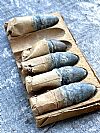
44 Caliber Paper based Bullet Cartridges in Wood Block
Click to Enlarge |
This is an original display of 5 combustible paper cartridges for the various .44 Revolvers of the Civil War period: Colt, Remington, Starr etc. They were shipped safely within a wooden block for safety in transit. These could be Bartholow patent cartridges. The five bullets sit atop paper cowls that held the powder charge. Considering age and paper base, these are in good solid condition with some exhibiting minor paper loss or tears.
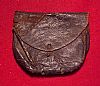
Locally made Musket Pouch possible CSA use
Click to Enlarge |
This is a really neat custom-made musket pouch suggestive of Confederate use. It may be pigskin rather than cowhide. Nicely aged with surface crazing. Only 6" tall by 7 1/2" wide. It actually has a homemade patch on one side! There are 2 compartments for cartridges and caps, etc. inside. A unique brass finial. It has no backstraps, so it was meant to hang from shoulder. The top corners have small tears where the original strap likely once attached.
|